The stunning Lotus Theory 1 concept car does away with buttons and relies on robotic bladders instead

Lotus has unveiled its latest concept car, which hints at what we can expect from the company’s high-performance future – including a pared-back interior that relies on robotic textiles instead of physical buttons.
As with many concept cars, there’s a lot of hypothetical thinking here, with much of the technology and performance figures providing a suggestion of what could come, rather than a true statement of intent.
Theoretically, a rather modest 70kW battery would send power to all four wheels, producing 968bhp and a 0-62mph sprint time of under 2.5 seconds. It all sounds very ‘modern hyper EV’ to us, but it is the tech inside the vehicle that is the most interesting.
Both designers and engineers have stripped everything back, which (much to the derision of pure Lotus fans) is not something the company has chosen to do with its current production cars, such as the large Eletre SUV and the Emeya four-door GT.
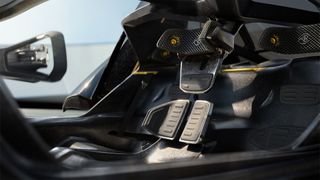
Peel back the reverse opening wrap-over doors of Theory 1 and you’ll find swathes of recycled carbon fibre, with the driver’s seat positioned dead centre and two small seats for flanking passengers, very much in the Gordon Murray vein of sports car design.
Adorning these seats, as well as the yoke-style steering wheel, is what the company calls LotusWear, which consists of a soft, adaptive textile that covers key sections and touch points.
Working alongside MotorSkins, which developed the technology to create dynamic clothing that can provide on-the-fly compression, thermoregulation and haptic feedback for athletes, Lotus has seen fit to use it as an innovative human machine interface.
When driving, both driver and passengers will receive notifications through the inflatable robotic textiles during the journey. This could be through a light pulsing on the left shoulder to indicate an upcoming left-hand turn, or a tap on the lower back to indicate an incoming smartphone message.

Similarly, inflatable pods on the steering wheel could indicate a blindspot hazard, or provide added grip as the pace quickens. The use-cases are vast, but the overall mission remains the same: to simplify the cockpit by ridding it of physical buttons.
As well as transparent screens, head-up displays and multi-use paddle switches, Lotus has also teamed up with technology company Carbon to produce 3D printed lattice structure headrests that can serve multiple purposes.
The soft, supportive structures are there for comfort and safety, but they also house a binaural audio system from KEF.
The ability to fire sound directly to the occupant of each seat means Lotus can add to the sensation of speed with a bespoke soundtrack, act as a noise-cancelling system on more mundane journeys, or to simply allow each passenger to experience individual media without sound clash.
Analysis: This is Lotus is riffing on its core values

A lot of the criticism leveled at Lotus since its takeover by Chinese owners Geely is that it has strayed far from Colin and Hazel Chapman’s dream of a lightweight, affordable and purely fun sports car.
The model line-up is now large, heavy and choc full of superfluous technology that fans of the original cars seemingly detest. But sales of the Elise and Evora tanked to the point that the company almost went bust, proving that there just isn’t enough demand for a ‘proper’ Lotus anymore.
Instead, the company has had to do what Porsche, Bentley, Ferrari and Lamborghini have in the past, and that’s create product that doesn’t traditionally fit in the line-up but sells exceedingly well (Lotus broke sales records in 2023) to ensure we are still treated to the fun stuff. Shout out to Cayenne, Bentayga, Purosangue and Urus.
However, Theory 1 appears to be hinting that Lotus is looking to go back to its roots, while not shunning future technology.
Stripping everything back is the very ethos upon which the company is built, but it’s doing so in a way that still incorporates Lidar, camera systems, in-car entertainment and even high levels of autonomous driving capabilities.
Granted, Theory 1 isn’t going to be a simple, lightweight two-seater, but like the Hyundai Ioniq 5 N, it looks like it is tackling what it means to be a performance car in the electric age.
You might also like

Lotus has unveiled its latest concept car, which hints at what we can expect from the company’s high-performance future – including a pared-back interior that relies on robotic textiles instead of physical buttons. As with many concept cars, there’s a lot of hypothetical thinking here, with much of the technology…
