Citing security concerns, the US is now looking to ban Chinese and Russian-made vehicles

Electric vehicles made in China could be banned in the US from 2027 if a proposed new rule is passed. The US Bureau of Industry and Security (BIS) has published a Notice of Proposed Rulemaking that would prohibit the import and sale of vehicles and components made by manufacturers “with a sufficient nexus” to the People’s Republic of China or Russia.
The proposed rule focuses on specific elements in electric vehicle (EV) hardware and software, and the potentially malicious use of the information and data required by them. The Vehicle Connectivity System (VCS) allows cars to communicate externally through Bluetooth, cellular, satellite or Wi-Fi modules, while the Automated Driving System (ADS) allows a car to operate without a driver. This ban would encompass any parts imported for use in American-made cars, as well as those built into vehicles from China and Russia.
If passed without change, the only vehicles that would be exempt are those related to agricultural or mining purposes. And, while a senior Biden administration official says “[Chinese] and Russian automakers do not currently play a significant role in the US auto market”, they believe it’s a necessary preventative strike given the sophistication of today’s electric cars and their growing centrality.
A statement from the White House clarifies that, “These technologies include computer systems that control vehicle movement and collect sensitive driver and passenger data as well as cameras and sensors that enable automated driving systems and record detailed information about American infrastructure.”
“While connected vehicles yield many benefits, the data security and cybersecurity risks posed by software and hardware components sourced from the PRC and other countries of concern are equally clear,” said National Security Advisor Jake Sullivan.
It was only this month that the US increased tariffs on Chinese EV imports to 100%, and this rule comes as China’s auto exports have boomed, increasing by more than 30% in the first six months of 2024 according to the Associated Press.
Though the proposal could still see change, if passed in its current state the new software ban would take effect on all vehicles with the model year 2027, with hardware provisions beginning with model year 2030.
More privacy, fewer options
This new rule can equally be viewed as a way to protect American electric vehicle manufacturing (and its considerably more expensive vehicles) as much as being about protecting Americans’ privacy and security.
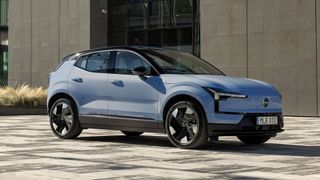
Despite heavy tariffs, cars like the Volvo EX30 undercut the Tesla Model Y in some markets, and according to The Atlantic, the average price for an EV in China is about $18,000 cheaper than the United States. Lei Xing, former Chief Editor at China Auto Review, says “If the 100 percent tariffs on made-in-China EVs were a wall, the proposed ban on connected vehicles would be a death sentence for China EV Inc.”
That’s not to say these new rules aren’t without merit. With the cameras, GPS tracking, microphones and other technologies of modern EVs, “It doesn’t take much imagination to understand how a foreign adversary with access to this information could pose a serious risk to both our national security and the privacy of US citizens” said Gina Raimondo, Secretary of Commerce.
However, Raimondo’s speculation of China causing mayhem by shutting down “hundreds of thousands of Chinese connected vehicles” aren’t likely to occur any time soon, given the insignificant role Chinese and Russian automakers play in the US. According to Statista as of August 2024, Tesla makes up 82.5% of the U.S. EV market, with the American-owned Ford (3%) and Chevrolet (2.9%), South Korean Hyundai (2.2%), and German BMW (1.8%), Volkswagen (1.7%) and Mercedes-Benz (1.4%) leaving only 4.5% split between Nissan, Kia and other manufacturers.

This obviously isn’t the first tech-related legal run-in between China and America. In 2022 equipment from Huawei and ZTE was banned, and Bytedance is still fighting the forced divesting of TikTok in court.
While the potential malicious use of American data is certainly something to be wary of, if this proposition becomes law the impact on EV pricing in the US could be significant. So, while this rule will see citizens remain protected against “countries of concern” using their data, they’d also miss out on some of the world’s cheapest electric vehicles.

Electric vehicles made in China could be banned in the US from 2027 if a proposed new rule is passed. The US Bureau of Industry and Security (BIS) has published a Notice of Proposed Rulemaking that would prohibit the import and sale of vehicles and components made by manufacturers “with…
