Japanese tech giant claims to offer data transmission solution 10x faster than current technologies to tackle AI speed bottleneck

- TDK’s Spin Photo Detector pushes AI data speeds ten times beyond today’s tech
- AI bottlenecks may vanish as TDK shifts focus from GPU to data transfer
- Spin Photo Detector uses laser-induced magnetism for ultrafast photoelectric conversion
Japanese manufacturer TDK has claimed it has achieved a major breakthrough in solving one of the most pressing problems in artificial intelligence. No, not GPU performance, but rather data transfer.
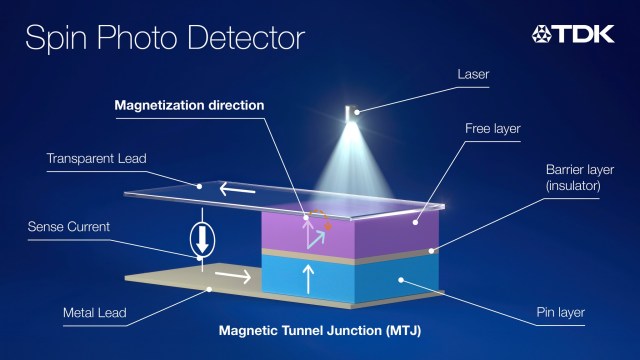
Its innovation, called the Spin Photo Detector, combines magnetic, optical, and electronic technologies to move data at speeds up to ten times faster than existing semiconductor-based photodetectors can offer.
TDK’s device reaches response speeds of just 20 picoseconds – or 20 trillionths of a second – using light at a wavelength of 800 nanometers.
TDK’s Spin Photo Detector
“This data transfer is the biggest bottleneck for AI rather than the semiconductor GPU performance,” said Hideaki Fukuzawa, senior manager of the company’s next-generation product development center.
“Since we can break through many of the current bottlenecks, we think this technology will be a game-changer for the AI and data center industry.”
To achieve this, TDK re-engineered its magnetic tunnel junction (MTJ) technology, previously used in billions of hard disk drive heads.
The MTJ structure is only 200 nanometers wide and integrates a single CoFeB free layer that responds to laser pulses. It allows switching from parallel to antiparallel magnetic states with 100% reliability under defined conditions.
Unlike semiconductors that rely on carrier generation and face limitations at short wavelengths, Spin Photo Detectors use electron heating, enabling faster speeds and broader spectral coverage. The MTJ elements are also resistant to cosmic rays, making them ideal for aerospace applications.
“The Spin Photo Detector holds remarkable promise, both from a scientific and technological perspective,” said Arata Tsukamoto, a professor of electrical engineering at Nihon University who collaborated with TDK on validation.
TDK’s device demonstrated effective operation across a wide range of wavelengths, from 300 nm to 1.6 µm. Its ultrafast analog light detection capability, energy efficiency, and compact size open up potential applications in AR/VR smart glasses, high-speed imaging, and space systems. This development could also help address power consumption issues in AI deployment.
The technology could serve markets where fast, low-latency data transfer is crucial for AI workloads and graphics-heavy tasks.
TDK expects to supply samples by March 2026 and is aiming for mass production within five years. Thanks to the few processing steps required, it expects to maintain a cost advantage and challenge major chipmakers like TSMC and Nvidia, who are investing heavily in silicon photonics.
Via Financial Times
You may also like
TDK’s Spin Photo Detector pushes AI data speeds ten times beyond today’s tech AI bottlenecks may vanish as TDK shifts focus from GPU to data transfer Spin Photo Detector uses laser-induced magnetism for ultrafast photoelectric conversion Japanese manufacturer TDK has claimed it has achieved a major breakthrough in solving one…
