Internet speeds 3.5 million times faster than US average are possible with current fiber optic cable tech – so how does 1,020,000 Gbps sound?

- Future networks could carry petabit speeds without new cable shapes
- Standard-diameter fiber hits new capacity-distance milestone in lab test
- US average internet speed is dwarfed by breakthrough optical transmission
Buried under city streets, countryside roads and the deep ocean floor lie the glass threads that carry almost everything we do online.
These strands, often no wider than a human hair, already move astonishing amounts of data, and now, Japanese researchers have pushed those limits even further – without changing the shape or size of the cable.
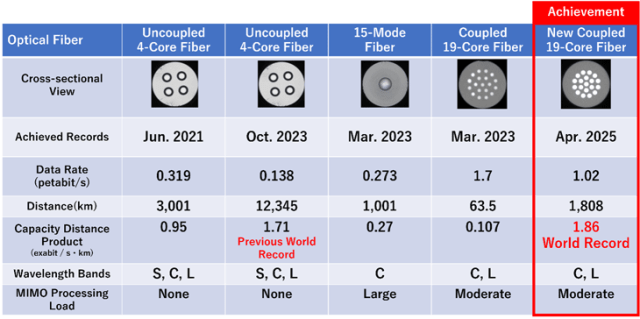
A team led by Japan’s National Institute of Information and Communications Technology (NICT), working with Sumitomo Electric and European collaborators, has achieved a transmission speed of 1.02 petabits per second over 1,808 kilometers.
A new world record
The test used a 19-core optical fiber with a standard cladding diameter of 0.125 mm, meaning it’s the same thickness as the single-core fibers already deployed in networks around the world.
Instead of requiring entirely new infrastructure, the cable squeezes 19 separate light paths into the space typically used for one.
That allows for a dramatic leap in capacity while staying compatible with existing systems.
It also marks the first time a petabit-class signal has traveled more than 1,000 kilometers in a standard-sized fiber.
The result sets a new world record for capacity-distance product at 1.86 exabits per second-kilometer.
To simulate a long-distance backbone, signals were looped 21 times through 86.1 km spans of the new fiber. Amplifiers boosted the signal at every pass and were carefully tuned to work across both the C and L wavelength bands for all 19 cores.
Using 180 wavelengths modulated with 16QAM, the system was able to handle huge volumes of parallel data streams.
After traveling the simulated route, the signals were separated by a multi-channel receiver using MIMO digital signal processing.
This avoided adding more fiber cores or expanding the cable diameter, which would have made integration with current networks harder.
To put the new achievement in context, the average US broadband speed in early 2025 is around 290Mbps. The new record of 1.02 petabits per second equals 1,020,000,000 Mbps – more than 3.5 million times faster.
The results were presented at OFC 2025 as a post-deadline paper, offering a glimpse at what future optical networks might look like.
Although it won’t transform work or home connections overnight, the research shows how far standard fiber can still go. The team now aims to refine amplifier efficiency and signal processing to move closer to real-world deployment.
With global data traffic continuing to grow, advances like this offer a way to stretch infrastructure further without the need to dig new trenches.
You might also like

Future networks could carry petabit speeds without new cable shapes Standard-diameter fiber hits new capacity-distance milestone in lab test US average internet speed is dwarfed by breakthrough optical transmission Buried under city streets, countryside roads and the deep ocean floor lie the glass threads that carry almost everything we do…
