Chinese researchers are looking to create a revolutionary type of hard drive based on organic materials but huge unknowns remain

- Chinese researchers are working to develop molecular hard drives with high capacity
- The drives use organometallic molecules to boost data density and efficiency
- A conductive atomic force microscope tip reads and writes molecular data
Chinese researchers are exploring the potential of organic materials to develop a new type of hard drive that could potentially store six times the amount of data compared to current mechanical models.
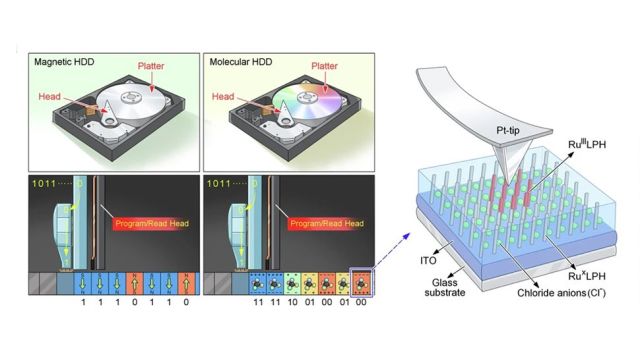
Traditional hard drives store data in binary form, relying on magnetized regions to represent ones and zeros, which limits storage capacity. Molecular hard drives overcome this by using self-assembled monolayers of organometallic complex molecules, such as RuXLPH, to significantly increase data density while maintaining ultra-low power consumption, measured at just 2.94 picowatts per bit.
A key component in the operation of molecular HDDs is the conductive atomic force microscope tip (C-AFM), which serves as the mechanical programming and read head. The tip applies localized voltages to the self-assembled monolayer, triggering redox reactions in the RuXLPH molecules. The tip’s nanoscale resolution allows precise control over molecular conductance states, allowing for multi-bit storage in an exceptionally small footprint.
You may like
Encryption at the molecular level
Another advantage of molecular hard drives is the enhanced security they offer. Unlike traditional drives that require separate encryption mechanisms, molecular HDDs feature in-situ XOR encryption at the molecular level. This capability allows secure data encoding and retrieval without additional hardware, reducing vulnerability to cyber threats.
The researchers demonstrated this by encoding and encrypting a 128×128 pixel image, proving the system’s ability to securely store and retrieve data.
The research was published in Nature Communications. The authors say future work will focus on improving miniaturization, increasing conductance states, and addressing environmental sensitivity.
Blocks & Files makes an interesting point however. “The working life of an atomic force microscope tip is currently measured at 50-200 hours in intermittent touch (tapping) mode versus 5-50 hours in continuous touch mode. Unless and until a long-lasting C-AFM tip can be created, this would seem to be a fatal flaw in their molecular hard drive concept. A second point is that the device has “ultralow power consumption of pW/bit range,” but this is for reading and writing, not spinning the disk, which would take more power.”
You might also like
Chinese researchers are working to develop molecular hard drives with high capacity The drives use organometallic molecules to boost data density and efficiency A conductive atomic force microscope tip reads and writes molecular data Chinese researchers are exploring the potential of organic materials to develop a new type of hard…
