11 basketball courts in 1 teaspoon: this new material, borne from the space age, could hold the key to next-generation batteries and ultra small power cells
- Researchers create a form of carbon with an incredible surface area
- This could allow the material to trap more substance including various chemicals
- Hypergolics are widely use in jet propulsion
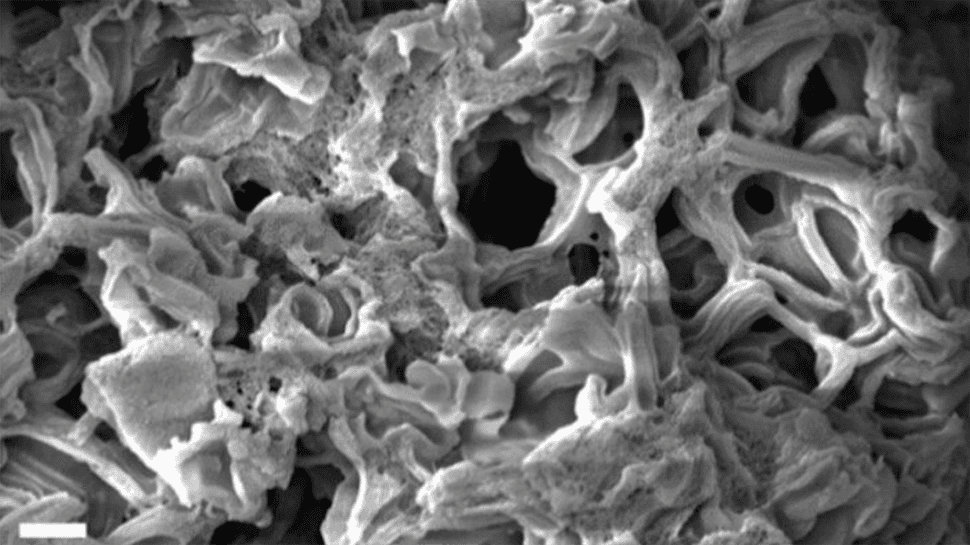
Researchers at Cornell University have developed a nanoporous carbon material with the highest surface area ever reported.
The breakthrough uses a chemical reaction akin to rocket fuel ignition and could be used to improve carbon-dioxide capture and energy storage technologies, potentially advancing the next generation of batteries.
Increasing the porosity of carbon is key to enhancing its performance in applications such as pollutant adsorption (where pollutants stick to the surface of the material) and energy storage. The new material boasts a surface area of 4,800 square meters per gram – comparable to the size of an American football field, or 11 basketball courts, condensed into a single teaspoon.
A bright future for batteries
“Having more surface per mass is very important, but you can get to a point where there is no material left. It’s just air,” said senior author Emmanuel Giannelis from the Department of Materials Science and Engineering, in Cornell Engineering. “So the challenge is how much of that porosity you can introduce and still have structure left behind, along with enough yield to do something practical with it.”
Giannelis collaborated with postdoctoral researcher Nikolaos Chalmpes, who adapted hypergolic reactions – high-energy chemical reactions typically used in rocket propulsion – to synthesize this carbon.
Chalmpes explained that by fine-tuning the process, they were able to achieve ultra-high porosity. Previously, such reactions were used solely in aerospace applications, but their rapid and intense nature proved ideal for creating novel nanostructures.
The process, detailed in ACS Nano, starts with sucrose and a template material, which guides the formation of the carbon structure. When combined with specific chemicals, the hypergolic reaction produces carbon tubes containing highly reactive five-membered molecular rings. A subsequent treatment with potassium hydroxide removes less stable structures, leaving behind a network of microscopic pores.
The researchers say the material adsorbs carbon dioxide nearly twice as effectively as conventional activated carbons, achieving 99% of its total capacity in under two minutes. It also demonstrated a volumetric energy density of 60 watt-hours per liter – four times that of commercial alternatives. This makes it particularly promising for batteries and small power cells, where efficient energy storage in compact spaces is critical, and opens pathways for designing electrocatalysts and nanoparticle alloys.
You might also like
Researchers create a form of carbon with an incredible surface area This could allow the material to trap more substance including various chemicals Hypergolics are widely use in jet propulsion Researchers at Cornell University have developed a nanoporous carbon material with the highest surface area ever reported. The breakthrough uses…
