When light meet bytes: Intel debuts crucial optical tech that will boost AI performance — OCI chiplet can move up to 4Tbps and consume nearly 70% less power than rivals

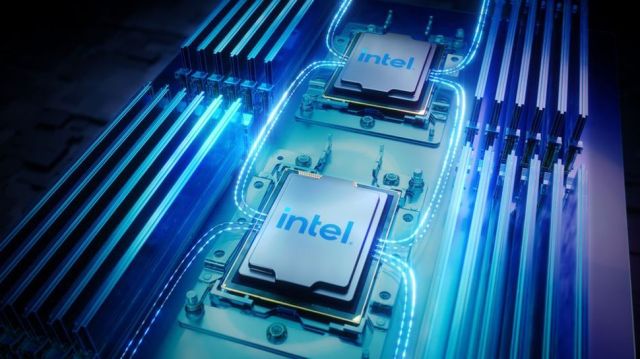
Intel has unveiled the industry’s first fully integrated bidirectional optical I/O chiplet at the recent Optical Fiber Communication Conference (OFC) 2024.
This optical compute interconnect (OCI), showcased by Intel’s Integrated Photonics Solutions group, supports 64 channels of 32Gbps data transmission in both directions over up to 100 meters of fiber optics.
The technology, which can be attached to CPUs and GPUs – a previously complicated task to achieve – addresses AI infrastructure’s increasing demand for higher bandwidth, lower power consumption, and longer reach.
Meeting AI demand
It’s well documented that AI-based applications, including LLMs and generative AI, are causing unprecedented demand in I/O bandwidth and driving the need for longer reach to support larger CPU/GPU clusters. Electrical I/O, which relies on copper traces, offers high bandwidth density and low power but is limited to short distances. Intel says its co-packaged optical I/O solution can transmit data over much longer distances with higher efficiency and reduced power consumption, vital for AI/ML infrastructure scaling.
The OCI chiplet integrates a silicon photonics integrated circuit (PIC) with on-chip lasers and optical amplifiers, with an electrical IC. It supports 4Tbps bidirectional data transfer, compatible with PCIe Gen5, using 8 wavelengths at 200GHz spacing on a single fiber. It also consumes just 5 pico-Joules (pJ) per bit, compared to 15 pJ/bit for pluggable optical transceiver modules.
Intel’s OCI chiplet is only a prototype right now, but company says it’s working with select customers to co-package OCI with systems-on-chips (SoCs) and system-in-packages (SiPs).
“The ever-increasing movement of data from server to server is straining the capabilities of today’s data center infrastructure, and current solutions are rapidly approaching the practical limits of electrical I/O performance,” said Thomas Liljeberg, senior director of Product Management and Strategy at Intel’s Integrated Photonics Solutions Group.
“However, Intel’s achievement empowers customers to seamlessly integrate co-packaged silicon photonics interconnect solutions into next-generation compute systems, and increases reach, enabling ML workload acceleration that promises to revolutionize high-performance AI infrastructure.”
More from TechRadar Pro
Intel has unveiled the industry’s first fully integrated bidirectional optical I/O chiplet at the recent Optical Fiber Communication Conference (OFC) 2024. This optical compute interconnect (OCI), showcased by Intel’s Integrated Photonics Solutions group, supports 64 channels of 32Gbps data transmission in both directions over up to 100 meters of fiber…
