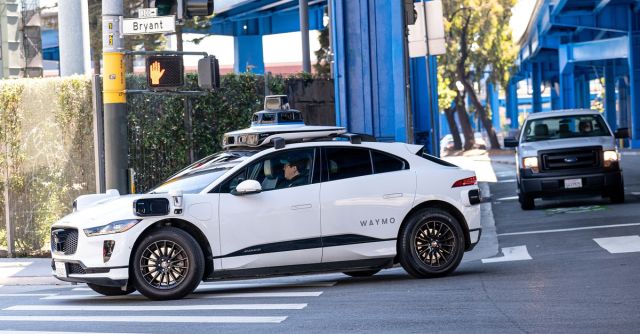
Waymo is using insurance data to make the case that its self-driving cars are safer than human drivers. The report, a result of the collaboration first announced last year between the Alphabet-owned company and the insurer Swiss Re, is intended to show how driverless vehicles crash less often and damage less property than human-driven vehicles.
Waymo is using insurance data about self-driving cars to bolster its safety case

Waymo’s data comes at a time of increased scrutiny of self-driving vehicles after California regulators voted to dramatically expand the ability of robotaxi companies to operate in San Francisco despite warnings from city officials about driverless vehicles blocking roads and delaying emergency responders.
The study compares Waymo’s liability claims data with those claims filed by human drivers calibrated by mileage and zip code. Based on Swiss Re’s data from over 600,000 claims and over 125 billion miles, “these baselines are extremely robust and highly significant,” Waymo says. The company plans to submit and publish this paper in a peer reviewed journal, according to Waymo spokesperson Katherine Barna.
Waymo’s data comes at a time of increased scrutiny of self-driving vehicles
According to the comparisons, Waymo’s vehicles are safer than human-driven ones. The company’s driverless vehicles, in which there was no safety driver behind the steering wheel, reduced the frequency of bodily injury claims by 100 percent, compared to Swiss Re’s human baseline of 1.11 claims per million miles. That was based on over 3.8 million miles of fully autonomous driving by Waymo in California and Arizona.
This held true for Waymo vehicles in autonomous mode with a safety driver behind the wheel. Those vehicles drove down injury claims by 95 percent for over 35 million miles, logging 0.09 claims versus 1.09 claims per million miles for the human baseline. And Waymo also saw a 76 percent drop in the frequency of property damage claims (a decrease from 3.26 to 0.78 claims per million miles) when compared to human drivers.
Waymo says this is the first time that liability claims data is being used to compare the safety performance of autonomous and human drivers.
“The Waymo Driver is already improving road safety in cities where we operate — a conclusion we’ve come to by analysing our Driver’s safety performance and through peer-reviewed research,” said Mauricio Peña, chief safety officer at Waymo, in a statement. “This cutting-edge study provides robust evidence that our Driver is in fact reducing injuries on the streets of San Francisco and Phoenix today.”
The data is important because there is still a fierce debate about the safety of driverless cars when compared to human drivers. Companies like Waymo and others say driverless cars are necessary as an antidote to the crisis of traffic fatalities, of which there are around 40,000 a year in the US. They point out that driverless cars never get drunk, tired, or distracted and are able to avoid the human errors that so often lead to crashes and deaths.
But there is a lack of certainty around the safety of driverless vehicles, mainly because there are far fewer AVs on the road than human-driven vehicles and, thus, less data from which to draw conclusions. Humans drive close to 100 million miles between fatal crashes, so we’re likely to need hundreds of millions of miles from autonomous vehicles before we can start to make more meaningful comparisons about safety.
In the meantime, Waymo has been trying to fill the gaps in what we know about self-driving cars by submitting its own data for analysis. Last year, the company produced two scientific papers comparing autonomous vehicle performance to human driving. The first analyzed and modeled response times when a crash is imminent, while the other presented a novel methodology to evaluate how well autonomous driving systems avoid crashes.
Waymo has also sought to measure the safety of its AVs by simulating dozens of real-world fatal crashes that took place in Arizona over nearly a decade. The Google spinoff discovered that replacing either vehicle in a two-car collision with its robot-guided vehicles would nearly eliminate all deaths.
Waymo is using insurance data to make the case that its self-driving cars are safer than human drivers. The report, a result of the collaboration first announced last year between the Alphabet-owned company and the insurer Swiss Re, is intended to show how driverless vehicles crash less often and damage…
