Want to see what an Exaflop supercomputer looks like (and how it is cooled)? Check out this video of Aurora, the world’s second most powerful HPC ever

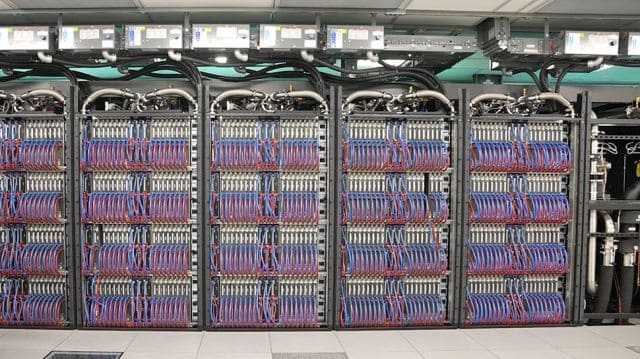
Few people will ever get to see inside a supercomputer for real, but it is possible to take a virtual tour. Nvidia previously opened the doors to Eos, one of the world’s fastest supercomputers, and now Department of Energy’s Argon National Laboratory has prepared a short 5-minute video guiding viewers through Aurora, its exascale supercomputer.
Aurora is already one of the fastest supercomputers in the world. HPC Wire ranked it number #2 in its top 500 list in November 2023. But that ranking was achieved with just “half of Aurora running the HPL benchmark”.
When fully up and running, Aurora will have a peak performance of about two exaflops and be tasked with solving important problems relating to climate change, human health, Material Science. As Argon says, thanks to supercomputers like Aurora, “problems that used to take years to solve now just take days.”
44,000 gallons of water cooling
As the video shows, Aurora is so big that a special state-of-the-art building had to be built just to house it. The video also covers Aurora’s stats, and they are staggering, as you might expect.
“There are 300km of optical cabling, so that would reach from Chicago to St Louis. It covers 10,000 square feet, two NBA basketball courts. And Aurora is about 600 tons. That is as heavy as the biggest passenger airplane in the world. It has 160 racks that are 8 feet tall and arranged in eight rows.”
Each Aurora rack has 64 blades, also called nodes, and each of those has six GPUs, two CPUs and RAM. Obviously Aurora generates a lot of heat, so there are 44,000 gallons of water flowing through pipes and cooling the supercomputer down.
You can take the tour of Aurora in the video below.
More from TechRadar Pro

Few people will ever get to see inside a supercomputer for real, but it is possible to take a virtual tour. Nvidia previously opened the doors to Eos, one of the world’s fastest supercomputers, and now Department of Energy’s Argon National Laboratory has prepared a short 5-minute video guiding viewers…
