Want to break the geekiest world record of them all? Here’s how engineers spent 75 days to calculate Pi to 105 trillion digits — just in time for Pi day

Engineers at StorageReview decided to do something incredibly geeky for this year’s Pi day (March 14 – 3/14) – beat their own record for calculating Pi. Considering that the previous record, achieved last year, was 100 trillion digits, the challenge was no mean feat. While – spoiler alert – they smashed the record, it did take them 75 days to accomplish it.
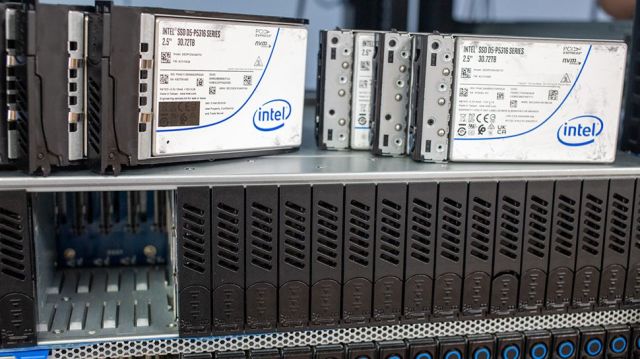
The task was achieved using a dual processor 128-core AMD EPYC 9754 Bergamo system, equipped with 1.5TB of DRAM and nearly a petabyte of Solidigm QLC SSDs.
The team started their computation on December 14, 2023, and finished on February 27, 2024, spanning 75 days. They used the Chudnovsky (1988) algorithm to calculate Pi, and the computation required a total memory of 1.36 TiB.
New challenges
The journey to 105 trillion digits of Pi – the new record – was not without fresh challenges. The team had to deal with performance-related issues, which led them to delve into the intricacies of parallel computing and hardware interactions. They discovered a CPU hazard specific to the Zen4 architecture involving super-alignment and its effects on memory access patterns.
The engineers also encountered a critical floating-point arithmetic error within the AVX512 code path of the N63 multiply algorithm. With remote assistance from the developer, Alexander Yee, they were able to diagnose and fix the problem, resulting in the successful computation.
Summing up, StorageReview’s Jordan Ranous noted, “The run to 105 trillion digits of Pi was much more complex than we expected. Upon reflection, we should have expected to encounter new issues; after all, we’re completing a computation that had never been done before. But with the 100 trillion computation completed with a much more “duct tape and chicken wire” configuration, we thought we had it made. Ultimately, it took a collaborative effort to get this rig across the finish line.”
Was it worth it? Ranous says, “While we rejoice with our partners in this record-breaking run, we must ask, “What does this even mean?” Five more trillion digits of Pi probably won’t make a huge difference to mathematics. Still, we can draw some lines between computational workloads and the need for modern underlying hardware to support them. Fundamentally, this exercise reflects that the proper hardware makes all the difference, whether an enterprise data center cluster or a large HPC installment. For the Pi computation, we were completely restricted by storage. Faster CPUs will help accelerate the math, but the limiting factor to many new world records is the amount of local storage in the box.”
You can watch the video of the record breaking attempt below.
More from TechRadar Pro

Engineers at StorageReview decided to do something incredibly geeky for this year’s Pi day (March 14 – 3/14) – beat their own record for calculating Pi. Considering that the previous record, achieved last year, was 100 trillion digits, the challenge was no mean feat. While – spoiler alert – they…
