Tiny heat pump that relies on changing ambient temperature could be key to powering IoT devices and sensors without batteries forever — Nanoparticles are critical to the process, posit scientists

As IoT technology progresses, the question of how to power these devices, particularly in locations where reliable electrical sources are scarce, presents a significant challenge.
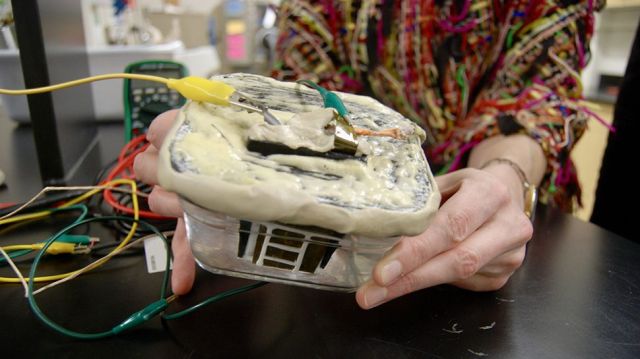
Researchers at the University of Utah’s College of Engineering have pioneered a new form of battery that could help solve this dilemma. The solution, which is at the proof of concept stage, comes in the form of a pyroelectrochemical cell (PEC).
Developed by associate professors of mechanical engineering Roseanne Warren and Shad Roundy, the integrated device harvests ambient thermal energy and converts it into stored electrochemical energy. This effectively creates a supercapacitor or battery, which could be ideal for IoT and sensor applications.
Low levels of energy
The device works by charging with changes in its surrounding temperatures, whether located inside a vehicle, an aircraft, or even underneath soil in an agricultural environment.
“We’re talking very low levels of energy harvesting,” Warren said, “but the ability to have sensors that can be distributed and not need to be recharged in the field is the main advantage. We explored the basic physics of it and found that it could generate a charge with an increase in temperature or a decrease in temperature.”
Whilst solar cells can provide an alternative power source of IoT devices, the practicalities often present issues. “In a lot of environments, you run into two problems,” said Roundy. “One is that it gets dirty over time. Solar cells have to be kept clean. So in these types of applications, they get dirty and their power degrades. And then there are a lot of applications where you just don’t have sunlight available. For example, we work on soil sensors that we put just under the top surface of the soil. You’re not going to get any sunlight.”
With the use of a pyroelectric composite material made of porous polyvinylidene fluoride (PVDF) and barium titanate nanoparticles as the separator in an electrochemical cell, the device’s electrical properties change as it’s heated or cooled. This action modifies the polarization of the pyroelectric separator. This shifting of temperatures in turn creates an electric field within the cell, moving ions around and allowing the cell to store energy.
Despite only producing up to 100 microjoules per square centimeter from a single heating/cooling cycle, this could be enough for the needs of some IoT applications.
The study, funded by the National Science Foundation, is the cover feature in the March 21 edition of the journal Energy & Environmental Science, published by the Royal Society of Chemistry.
More from TechRadar Pro

As IoT technology progresses, the question of how to power these devices, particularly in locations where reliable electrical sources are scarce, presents a significant challenge. Researchers at the University of Utah’s College of Engineering have pioneered a new form of battery that could help solve this dilemma. The solution, which…
