Tiny French chip startup challenges mighty Amazon to produce formidable quantum chip – inspired by a famous cat


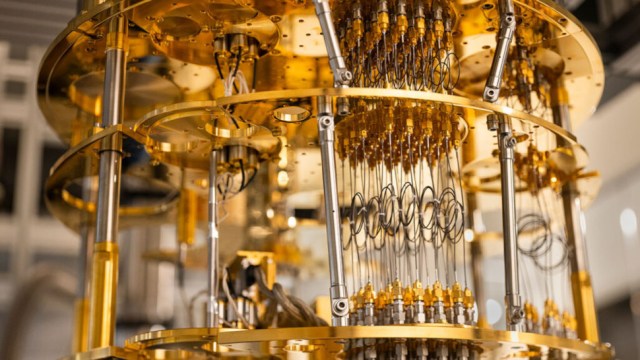
Quantum computers have shown amazing promise in recent years, with companies from IBM to Google building increasingly powerful machines that are expected to many areas fundamentally, from encryption to medical research.
Quibits – quantum bits that occupy a superposition of both 1 and 0 at the same time – are the building blocks of quantum machines. But today’s most powerful quantum computers are hugely inefficient due to a phenomenon called ‘quantum error’. This affects more than 1,000 qubits for every single unaffected ‘logical’ quibit.
Now, French startup Alice & Bob are testing a new kind of quibt that’s designed to withstand quantum error – by taking a leaf from the original Shrodinger’s Cat experiment around which the theory of quantum superposition is based.
Investing in the power of ‘cat state’ qubits
Rather than encoding qubits by using varying energy levels, for instance, Alice & Bob’s strategy involves establishing two diametrically opposed states – such as the state of life or death experienced by the aforementioned cat. Specifically, they’ve used superconducting microwave resonators that fluctuate between two oscillatory states.
The researchers say using a quantum computer to break RSA-2048 encryption would need roughly 22 million normal quibits, but just 350,000 of its ‘cat state’ qubits. And, for every single logical qubit, Alice & Bob would need just 40 quibits. Such is the powerful nature of this reserach, Amazon has also started work on its own ‘cat state’ quibits.
“When we first learned that Amazon was working on cat qubits, obviously our first reaction as a young startup was to sweat heavily,” Peronnin told the Institute of Electronic Engineering’s (IEEE) Spectrum publication.
“But then we slept on it and realized that it might be the best thing to have happened to us. We’re not competing about who’s going to win; it’s cat qubits versus the rest of the possible technologies, so for us, it’s great external validation.”
These ‘cat states’ are highly resistant to bit flip – which means a qubit’s state flips from 1 to 0, or the other way around. They do, however, tend to be more vulnerable to phase flip, in which quibits flip between one of two opposing phases, but the researchers said one kind of error is easier to resolve than two.
The company hope to have created a 14-qubit system by the end of 2023, but the startup will need a further six months to calibrate it, so stya tuned for more information soon.
More on quatum from TechRadar Pro
Quantum computers have shown amazing promise in recent years, with companies from IBM to Google building increasingly powerful machines that are expected to many areas fundamentally, from encryption to medical research. Quibits – quantum bits that occupy a superposition of both 1 and 0 at the same time – are…
