An ominous, 62-foot-long clock looms over New York City’s iconic Union Square, and it’s about to tick past a worrying milestone. It’s called the Climate Clock, and it counts down how much time the world has left to stop climate change from becoming exponentially worse.
Time is running out on the Climate Clock

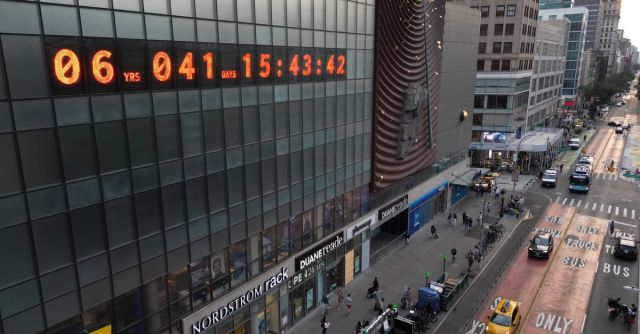
As anyone who’s experienced the weather lately knows, the situation is already bad. The world had its hottest week on record at the start of the month, according to preliminary data, with heatwaves still smashing local records across the Northern Hemisphere. And that’s just one way climate change is bringing on dangerous new extremes.
Today, the planet is about 1.1 degrees Celsius hotter than it was before the Industrial Revolution, thanks to carbon dioxide emissions from burning fossil fuels. It’s what’s driving more intense heatwaves, wildfires, storms, and sea level rise. That’s why world leaders agreed, as part of the landmark Paris agreement, to keep the planet from warming much more than it already has. Every fraction of a degree comes with more severe consequences.
Every fraction of a degree comes with more severe consequences
The Climate Clock shows how much time is left before continued CO2 emissions lock in at least 1.5 degrees of global warming, a key threshold for global climate goals under the Paris agreement. Today, the time left on the clock falls under six years. In other words, if people keep pumping out roughly the same amount of CO2 pollution over the next five years or so, we’ll no longer be able to limit climate change to just 1.5 degrees of warming.
The Climate Clock’s founders are holding events across five continents today to call attention to the dwindling time left, calling it a Climate Emergency Day. That includes a vigil below the giant digital clock that has faced Union Square since 2020.
“The best day to have taken action was yesterday. But we’re using [climate] data to create a timeline that is empowering for governments and activists to demand change,” says Becca Richie, global community manager of the Climate Clock organization that grew after the flagship clock was set up in New York City. “It is possible to enact the solutions we need in that timeframe and stay below 1.5 degrees.”
The clock started out as an artsy form of activism. It’s supposed to be a symbol, sort of like the Doomsday Clock meant to serve as “a metaphor for how close humanity is to self-annihilation.” The Climate Clock in Union Square was initially just supposed to be displayed during New York’s Climate Week in 2020, but it has since permanently replaced the 24-hour clock unveiled in 1999 as part of an art installation called Metronome.
The clock reflects data from the Mercator Research Institute on Global Commons and Climate Change (MCC) in Berlin. It’s not counting down to the exact date global average temperatures might rise above 1.5 degrees Celsius. Instead, it’s estimating how much time is likely left before humans produce enough carbon dioxide pollution to trigger at least 1.5 degrees of warming.
That’s under the assumption that global emissions keep up at a pace similar to 2019 before the covid-19 pandemic caused a temporary drop in pollution as economies slowed down. Unfortunately, pollution has picked back up to pre-pandemic levels. Last year was even a record-high year for energy-related CO2 emissions.
That makes every minute count on the Climate Clock. The display in Union Square also shows key benchmarks for “lifelines” that could keep the world on track to limiting global warming to 1.5 degrees. One of those lifelines is switching to renewable energy, and the clock periodically displays the percentage of global energy consumption sourced from renewables like wind and solar energy — a little under 14 percent today.
“Action is needed now. Energy infrastructure and structural change is not something that you do in a couple of months. It’s something that needs years,” says Sabine Fuss, who leads the working group on sustainable resource management and global change at MCC. “Even if you have marginally more time, it still means that you have to act immediately.”
An ominous, 62-foot-long clock looms over New York City’s iconic Union Square, and it’s about to tick past a worrying milestone. It’s called the Climate Clock, and it counts down how much time the world has left to stop climate change from becoming exponentially worse. As anyone who’s experienced the…
