The Xiaomi 14 and 14 Pro are the first to house Qualcomm’s brand-new chipset

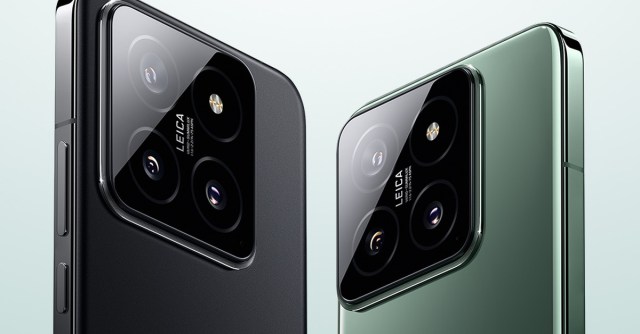
Qualcomm’s Snapdragon 8 Gen 3 is just a couple of days of old, and per usual, Xiaomi has already announced new flagship phones that put it to use. The Xiaomi 14 and 14 Pro will be exclusive to China before a likely global (minus the US) launch, but for now, the AI-heavy feature set and a new Android skin called HyperOS give us a pretty good idea of what’s to come in 2024.
The Xiaomi 14 comes with a 6.3-inch screen, and the 14 Pro offers a 6.7-inch screen. They each claim a peak brightness of 3,000 nits, and they’re both LTPO displays with 1-120Hz adaptive refresh rates. The 14 comes with a flat display and narrow bezels measuring 1.61mm on three sides — there’s an itty-bitty chin with a 1.71mm bezel along the bottom.
The 14 Pro’s display area is flat, but the bezels are sort of tucked into a curve around the edges and corners of the panel. They each strike a similar overall shape — the 13 Pro had more dramatic curves along the edges with narrow side rails, but this time around, they’re both much more flat along the back and sides.
The 14 Pro comes with a variable aperture main camera lens with 1,024 stops between its f/1.4 maximum and f/4.0 minimum apertures. That’s more flexibility than the 13 Ultra offered, which could only use two stops. Does anyone actually need variable apertures that precise on a lens that small? Extremely doubtful, but hey, it’s cool. Both the Xiaomi 14 and 14 Pro come with Leica-branded 50-megapixel main cameras, a roughly 3x or 75mm equivalent telephoto camera, and a 50-megapixel ultrawide.
They ship with HyperOS, a new system developed by Xiaomi that’s based on Android. It’s designed to run on a range of devices across mobile, computing, automotive, and home. It’s supposed to bring all of the devices in Xiaomi’s ecosystem together to work more easily with each other, allowing you to use your phone’s camera with your computer or access your phone’s mobile data from your tablet. Easy cross-device compatibility has been a major focus at this year’s Snapdragon Summit, too, so no doubt the 8 Gen 3 chipset plays some role in that.
And it wouldn’t be a 2023 technology announcement without AI in the mix; the 14 and 14 Pro will run AI foundation models on-device, which is a marquee feature of the 8 Gen 3. It enables some pretty pedestrian stuff, like summarizing webpages and videoconference transcripts. Xiaomi is also working on more ambitious features, like generating AI portraits that put you in different scenes across the globe — you know, the scary AI stuff.
That’s the overall vibe I’m predicting for AI phone features in 2024: partly unsettling and partly useful. Will it redefine our understanding of a photograph? Maybe, but it will probably make meeting note-taking way easier along the way. Progress! We’re expecting to see the Snapdragon 8 Gen 3 in plenty more devices in the coming months, so stay tuned. In the meantime, Xiaomi’s devices are up for preorder: the Xiaomi 14 starts at CNY 3,999 and the 14 Pro starts at CNY 4,999.
Qualcomm’s Snapdragon 8 Gen 3 is just a couple of days of old, and per usual, Xiaomi has already announced new flagship phones that put it to use. The Xiaomi 14 and 14 Pro will be exclusive to China before a likely global (minus the US) launch, but for now,…
