The Social Reckoning is a tepid thriller that reminds us of how we got here
When David Fincher’s The Social Network premiered in 2010, many people still thought of Mark Zuckerberg as a genius who had revolutionized the world by creating Facebook. Writer Aaron Sorkin’s script was critical of Zuckerberg’s character and his ruthless approach to doing business, but it also helped mythologize the co-founder at a time when the general public was much more enchanted by Silicon Valley. When Zuckerberg said in 2014 that he’d been hurt by the film’s depiction of him, Fincher said he was “sorry that it did” and admitted that he “wouldn’t want a movie made about the things I did when I was 19 years old,” either. Fincher’s apology was a reflection of how much grace the public was willing to extend to the world’s (then) youngest billionaire. But in 2026, it is hard to imagine anyone having all that much sympathy for the man running Meta.
The film lacks the propulsive energy that made The Social Network feel operatic.
Similar to the way The Social Network spun details from Ben Mezrich’s book The Accidental Billionaires into a riveting drama, writer-director Aaron Sorkin’s The Social Reckoningweaves a narrative around The Wall Street Journal’s bombshell reporting with Facebook whistleblower Frances Haugen. Billed as a companion piece rather than a direct sequel, The Social Reckoning chronicles Haugen’s time within Facebook and uses her story to illustrate how the company’s focus on exponential growth turned it into a societal threat. Zuckerberg looms large in the movie, but Sorkin feels far more interested in focusing on the friction that exists between traditional media and tech giants.
Though The Social Reckoning’s core messages about how our lives have been negatively impacted by the rise of social media algorithms are potent, the film lacks the propulsive, thrilling energy that made The Social Network feel operatic. The film does an excellent job of presenting our present day reality as the end result of events Zuckerberg and Facebook helped facilitate. But for all of its insight, The Social Reckoning still feels like a feature that’s arriving a little too late to have a meaningful impact.
The Social Reckoning spends much of its 112 minute runtime ping ponging back and forth through the years when Haugen (Mikey Madison) worked as a product manager on Facebook’s civic integrity team. As the film opens in 2019, Haugen’s just beginning to understand how hate speech and misinformation are being amplified by the platform’s algorithms. Haugen genuinely believes that Facebook could take steps to mitigate these harms if any of her colleagues would take them seriously. But when she realizes that no one else in the company is willing to speak up about Mark Zuckerberg’s (Jeremy Strong) single-minded focus on boosting Facebook’s engagement at all costs, she turns to Wall Street Journal reporter Jeff Horwitz (Jeremy Allen White).
Sorkin presents Haugen and Horwitz as uneasy allies. The duo both understand that Facebook is the news for millions of people, but the only way they can report the truth about what’s happening within the company is by doing things the old fashioned way. You can hear echoes of Sorkin’s The Newsroom in Horwitz’s quippy exchanges with taciturn bureau chief Christina (Betty Gilpin) and overworked interns (Aidan Laprete, Kelley Pereira) about the importance of their work. The film frames its reporter characters as competent heroes who are trying to do the public an important service. It does not consistently do the same for the whistleblower, and Sorkin writes Haugen’s dialog with a degree of levity that often feels at odds with the gravity of the larger story.
Madison and White try their best to turn Sorkin’s script into dialog that sounds like it might be spoken by regular humans.
The Social Reckoning feels most like a proper thriller in tense moments when Haugen and Horwitz are secretly meeting in parks and hotel rooms to pore over damning internal documents detailing how Facebook was well aware of its products’ potential to do harm. The movie effectively depicts Facebook — in its pursuit for growth — knowingly becoming a place where conspiracy groups could thrive and radicalize people. Sorkin doesn’t go so far as to solely blame Facebook for turning the modern internet into a nightmare that’s flooded with ragebait and intentionally deceptive information. But The Social Reckoning does make the implicit argument that things might not be so bad today if Zuckerberg had acted more conscientiously in his quest to stay one step ahead of his competitors.
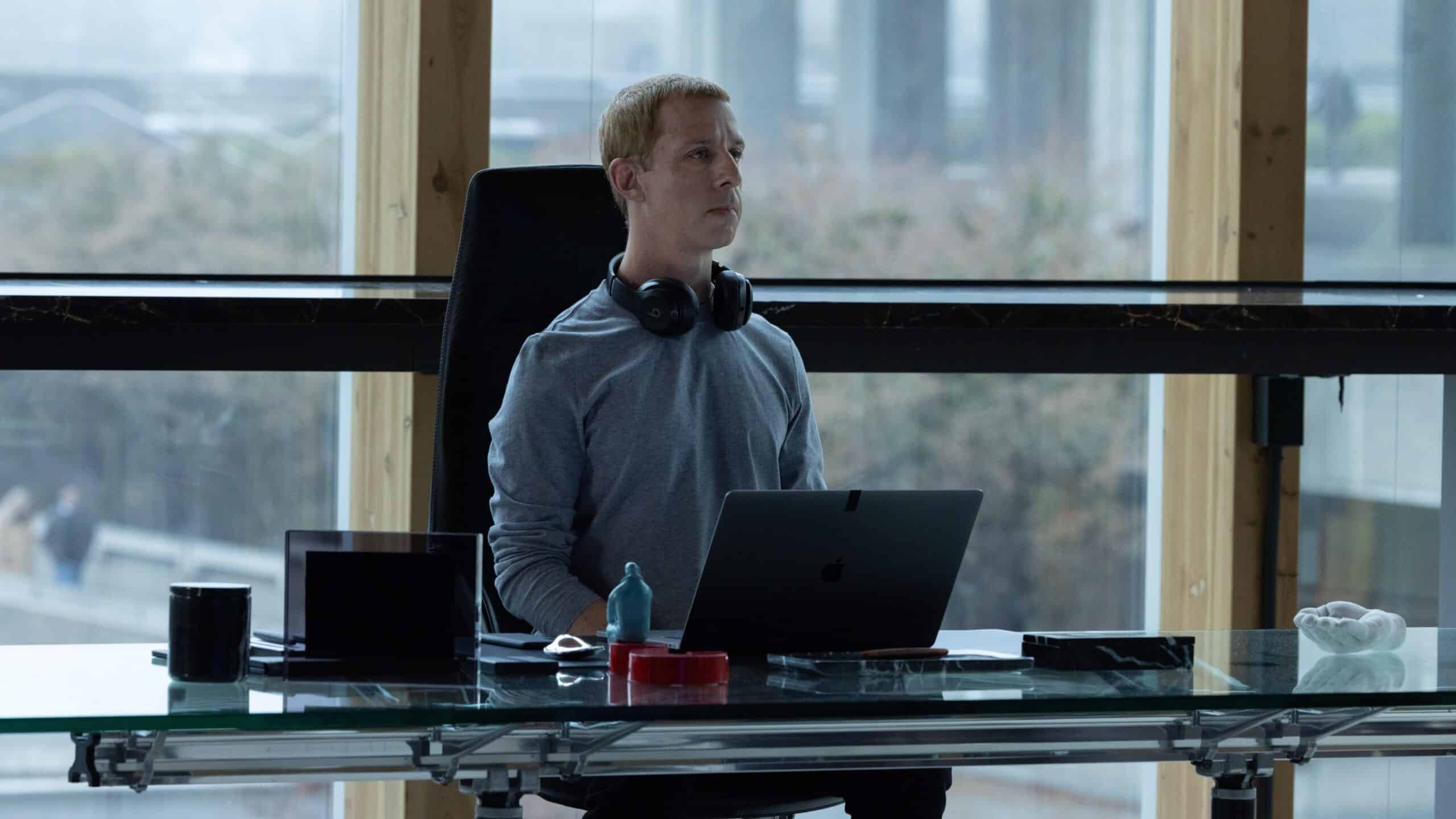
Though Madison and White try their best to turn Sorkin’s script into dialog that sounds like it might be spoken by regular humans, the writer-director’s penchant for rapidfire back-and-forths gets the better of him here. Sorkin clearly wanted to make The Social Reckoning as dense with information as he possibly could, but in doing so, he made it harder for the movie to work as an entertaining drama. The Social Reckoning truly shines in its handful of scenes that zoom in on an older, more calculating Zuckerberg as he’s preparing to speak at Congressional hearings. Whereas Jesse Eisenberg played Zuckerberg in The Social Network with a quiet vulnerability, Strong leans into an unsettlingly robotic aura that makes his performance feel studied. Strong’s Zuckerberg gives you the distinct sense that he is a man whose success is a testament to his willingness to prioritize profit over people’s well-being.
Especially for those who didn’t follow the Wall Street Journal’s Facebook reporting in real time, The Social Reckoning may serve as a useful recollection of how the company was — at one point, at least — held somewhat accountable for its actions. But the movie also serves as a bleak reminder of how there still hasn’t really been a substantive reckoning that fundamentally changed the way people interact with Meta’s (née Facebook) products. Sorkin seems to believe that a day may come when the public decides that companies like Meta can’t be trusted with the power to shape our perceptions of reality. It’s a hopeful thought, but in 2026, it feels like a dream that has already gotten away from us.
The Social Reckoning also stars Bill Burr, Wunmi Mosaku, Billy Magnussen, Patrick Fischler, and Nelson Franklin. The movie hits theaters on October 9th.
When David Fincher’s The Social Network premiered in 2010, many people still thought of Mark Zuckerberg as a genius who had revolutionized the world by creating Facebook. Writer Aaron Sorkin’s script was critical of Zuckerberg’s character and his ruthless approach to doing business, but it also helped mythologize the co-founder…
