About a year ago, I wrote a story with the headline “The hyperloop is dead for real this time,” based on the news that Hyperloop One, one of the biggest companies pursuing Elon Musk’s dream of tube-based, 700mph travel, had shut down.
The hyperloop lives on as a 1/12th scale model in Switzerland
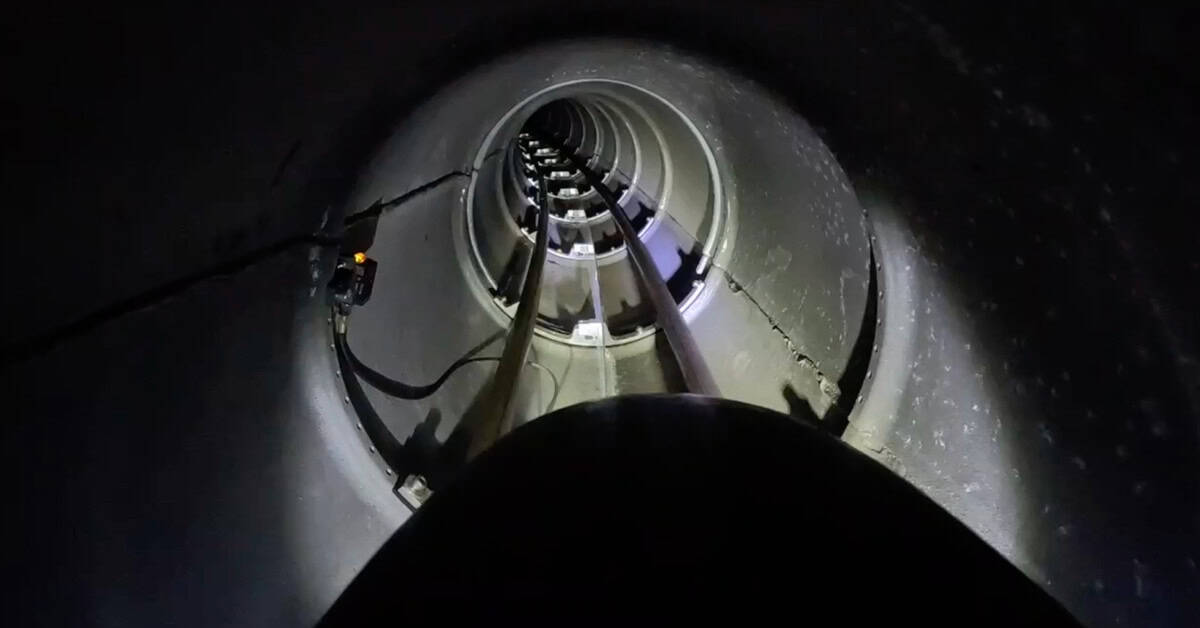
Well, I stand corrected. The hyperloop, in fact, lives on — as a 1/12th scale model in Switzerland.
Sure, this isn’t exactly the full realization of Musk’s 2013 white paper, in which he theorized that aerodynamic aluminum capsules filled with passengers or cargo could be propelled through a nearly airless tube at speeds of up to 760mph. These tubes, either raised on pylons or sunk beneath the earth, could be built either within or between cities. Musk called it a “fifth mode of transportation” and argued it could help change the way we live, work, trade, and travel.
The idea is being put to the test in Lausanne, Switzerland, where a 120-meter circular test track is being operated by a team that includes the Federal Institute of Technology Lausanne (EPFL), the School of Business and Engineering Vaud (HEIG-VD), and Swisspod Technologies. This week, the group announced that it had conducted “the longest” hyperloop test of its kind: traveling 11.8 km (7.3 miles) at a speed of 40.7km/h (25.3mph).
The circular test track has a circumference of 125.6 meters (412 feet) and a diameter of 40 centimeters (15.7 inches). It sounds modest, but the group claims that in a full-scale system, their test “directly translates” to a journey of 141.6 km (88 miles), which is about the distance between Geneva and Bern, or San Francisco to Sacramento, and speeds of up to 488.2 km/h (303.4mph).
The project is called LIMITLESS, which stands for Linear Induction Motor Drive for Traction and Levitation in Sustainable Hyperloop Systems. During the test, the team “monitored the performance of vital subsystems,” including propulsion, communication infrastructure, power electronics, and thermal management. They assessed “energy consumption, thrust variations, [linear induction motor] response, and control during acceleration, cruising, coasting, and braking scenarios.”
Of course, a 1/12th-scale circular test track is hardly a sign that the hyperloop is alive and well. Most of the startups and companies pursuing a full-scale hyperloop have shut down, victims of financial mismanagement, as well as infrastructure and regulatory hurdles. Critics said that while the hyperloop may be technically feasible, it still only amounts to vaporware. It’s been called a “utopian vision” that would be financially impossible to achieve.
But the Swiss team is undeterred, promising to conduct a battery of future tests to further validate the system. Swisspod CEO Denis Tudor said the group plans to test its first freight product soon, and is currently building a larger test track in the US.
“This is a key step toward making hyperloop for passengers a reality and changing how we connect, work, and live,” he said.
That would be a feat unto itself, considering that no full-scale hyperloops exist anywhere in the world. Musk’s test tunnel in California is gone. The man himself has become more enamored with campaigning for Donald Trump than solving the problem of car traffic.
The Boring Company, Musk’s tunneling operation, is still digging underground passageways in Las Vegas — but for Teslas, not hyperloops. The future, it would seem, is nearly the same as the present.
About a year ago, I wrote a story with the headline “The hyperloop is dead for real this time,” based on the news that Hyperloop One, one of the biggest companies pursuing Elon Musk’s dream of tube-based, 700mph travel, had shut down. Well, I stand corrected. The hyperloop, in fact,…
