‘That’s our next mission — proving that games are art’: meet Story Kitchen, the bold, trail-blazing studio behind the popular Sonic movies that wants to turn your favorite game into the next movie or TV hit

“It is easier, but it’s not easy,” Story Kitchen co-founder Dmitri Johnson interjects.
I’m midway through an in-depth conversation with Johnson and business partner Mike Goldberg about their pioneering entertainment company when the former clarifies something he alluded to earlier.
The topic in question? Pitching movies and TV shows based on video game properties to other studio figureheads is still challenging. That’s in spite of myriad recent examples of popular game franchises being turned into other screen-based art forms that have achieved critical and commercial success.
Latest Videos FromTechRadar
“We’re working every day to continue changing the stigma that games are only for kids and lazy people who still live in their mom’s basement,” Johnson adds with a wry smile. “These are artists and storytellers in their own right — and their work deserves to be seen by more people.”
Press start

You probably haven’t heard of Story Kitchen, but you definitely know the video game adaptations they’ve helped to shape.
From Paramount Pictures’ money-spinning Sonic the Hedgehog film franchise and Netflix‘s animated Tomb Raider show, to Prime Video‘s forthcoming TV re-imaginings of the aforementioned Lara Croft-fronted game series and Dontnod’s beloved first Life is Strange title, Story Kitchen is at the forefront of what’s unsurprisingly being labeled the ‘golden age’ of video game adaptations.
These are artists and storytellers in their own right — and their work deserves to be seen by more people
Dmitri Johnson
It’s a cinematic epoch some believed would never happen — and with good reason. The 1990s and early 2000s are littered with examples of maligned video game movies, including — but by no means limited to — 1993’s The Super Mario Bros. Movie, 2005’s Doom, and 2003’s House of the Dead, the latter of which is one the worst-rated films on popular review aggregation website Rotten Tomatoes.

With so many entertainment giants failing to understand the source material, the ‘videogame adaptation curse’ — a phrase Goldberg says “sounds really good when stories are written about it” — became a catch-all term for these and similarly crucified productions. Combine that with the notion that, as Goldberg notes, “Hollywood didn’t respect the gaming community, developers, or publishers”, and it seemed that video games would forever be viewed as the runt of the visual media landscape.
That was until dj2 Entertainment, the precursor to Story Kitchen co-founded by Johnson and Dan Jevons in 2011, took a leap into the unknown.
The company’s primary goal was simple: make Hollywood believe that video game stories were worth telling and investing in. Predictably, Hollywood just didn’t see the appeal of turning games into movies or TV shows, and countless rejections followed.

Then came the first Sonic the Hedgehog film. After slowly and methodically earning the trust and respect of SEGA, Johnson convinced the Japanese videogame titan and, later, Paramount Pictures that people wanted to see the Blue Blur star in his own movie.
A few notable setbacks, including the titular character’s speedy redesign after fans attacked his initial look following the release of Sonic‘s first trailer, followed. Fast-forward to early 2020, though, and, despite the pandemic bringing Sonic the Hedgehog‘s theatrical run to a premature end, the action-adventure comedy grossed $320 million worldwide. On a reported budget of $90 million, it more than recouped its production and marketing costs.
“Dmitri always believed that, with education and respect, a different result would occur,” Goldberg says. “And, he was right.”
‘It’s a new era — but not every game should be adapted’
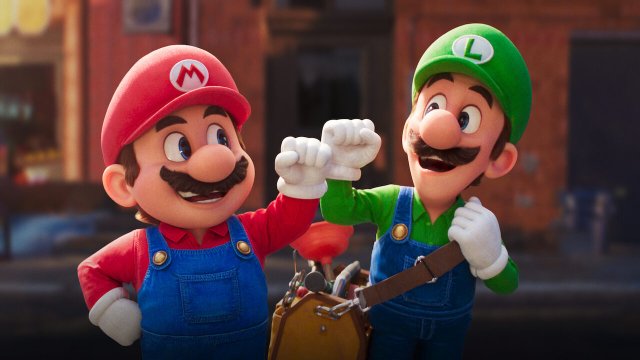
A lot has happened in the short time since Sonic’s big-screen debut, one that Goldberg describes as “an absolute game changer in the Hollywood ecosystem”.
He’s not wrong. Film adaptations of other iconic and/or hugely popular game series, including Mario and Minecraft, have earned billions at the global box office. Meanwhile, TV retellings of hit franchises like The Last of Us on HBO Max, and small-screen projects that expand on existing game universes, including Fallout on Prime Video and Netflix’s League of Legends animated program Arcane, have drawn universal acclaim, won multiple awards, and introduced millions more people to stories, characters, and worlds they would never have connected with otherwise.
We don’t see this as a fleeting moment for video game adaptations
Mike Goldberg
Suffice it to say, the explosion of video game adaptations is indicative of an industry-wide paradigm shift that also allowed dj2 Entertainment to level up its own game. Indeed, by investing the metaphorical skill points into the company’s evolution from dj2 Entertainment to Story Kitchen, onboarding industry talents like Elena Sandoval and Timothy I. Stevenson, and signing first-look deals with Amazon in February 2022 and DreamWorks Animation in May 2024, Johnson, Goldberg, and company are well-placed to help create the next wave of gaming transmedia hits.
At the time of publication, around 30 projects, some of which have already found homes and others that’ll be shopped around Hollywood, are in the works at Story Kitchen HQ. That might sound a lot, but it’s a mere raindrop in the ever-expanding gaming ocean. So, why doesn’t Story Kitchen just take a long list of game titles to film studios, TV networks, and the world’s best streaming services, and reel them off until one piques their interest?
“It’s a new era, but not every game should be adapted,” Golberg replies, “And not every game should be adapted right now. We want to be a friend and advocate for the space, though, because we don’t see this as a fleeting moment [for video game adaptations]. We think it’s got long-term potential, so we’re working to ensure that we see that through.”
We don’t go into things like ‘how many copies did this game sell?’
Dmitri Johnson
That’s not to say Story Kitchen is only focused on adapting the biggest game franchises. AA and indie titles are as much a part of the pitching process, if not more so, than their flashier, big-budget counterparts.
“We don’t go into things like ‘how many copies did this game sell?’,” Johnson says. “We actually despise that question and refuse to answer it at this point. We respond with ‘here’s why these characters and stories are incredible’ and ‘here’s why it’s something we’ve never seen before’.
“What it really boils down to is passion,” he continues. “What are the things that we can’t stop thinking about and have to pursue? Once that process starts, we’re convinced something has to be made, and that translates into our meetings with other companies. Initially, it might not necessarily make sense to them, but they all want to hear the pitch because it’s coming from a place of passion, so most networks and studios are excited when we take something out to them. This isn’t a cash-grab — these conversations are happening because we actually care.”
Prime-d for more success?

And care, Johnson and Goldberg certainly do. The multi-billion-dollar-spinning Sonic franchise, which currently comprises three movies and a Knuckles TV spin-off on Paramount+, has improved with each new entry.
As of July 2026, a fourth flick is deep in post-production ahead of its March 19, 2027 release date. An untitled Shadow-fronted off-shoot project is also reportedly in the works, though Johnson and Goldberg declined to speak about it because, as Goldberg rightfully points out, “there are levels of NDAs (non-disclosure agreements) we must respect.”
Sonic the Hedgehog 4 isn’t the only thing that’ll roll off the Story Kitchen production line next year. Indeed, two TV projects are expected to make their Prime Video debuts in 2027, the first of which should be a Tomb Raider TV adaptation that Johnson admits has been “years in the making”.
New cast confirmed for upcoming Prime Video Tomb Raider series including Sigourney Weaver, Jason Isaacs, and more.As previously announced, the Prime Video series stars Sophie Turner as Lara Croft, led by Phoebe Waller-Bridge serving as creator, writer, executive producer and… pic.twitter.com/a9Gr1g5x0vJanuary 6, 2026
Overseen by Fleabag‘s Phoebe Waller-Bridge, it’ll star Sophie Turner as gaming icon Lara Croft. Amazon revealed a perfect first-look shot at Turner in Croft’s classic tank top and shorts combo as principal photography got underway in January and, while filming was halted in March due to a “minor injury” sustained by Turner, there’s nothing to suggest it’ll delay the live-action series’ launch.
Thanks to a partnership Story Kitchen established with Tomb Raider custodians and videogame developer Crystal Dynamics during development on Netflix’s Tomb Raider animated show, Johnson says “we had a very clear blueprint of how to move together as partners”. So, when Amazon, which already had an agreement with Crystal Dynamics to publish future Tomb Raider games, proposed making a live-action TV show, it seemed like a lightning-in-a-bottle moment for all involved.
We’re not the type of people who hype up their own s**t
Dmitri Johnson
“Every decision [on the show] is made with Crystal Dynamics’ sign-off,” Johnson reveals. “So, season one has their blessing and they’re very hands-on, but they also respect Phoebe, who’s a super-fan, and her perspective of what a live-action Tomb Raider project should be.
“We’ve actually just started seeing rough cuts, and we were grinning like 10 year olds the entire time. It’s going to be good. By the way, we’re not the type of people who hype up their own s**t. It’s going to be something that your mom can come across and not know that it’s based on a 30-year-old videogame franchise. We don’t want it to be a niche adaptation just for core fans, who we absolutely honor and will make feel seen. But, if we do our job right, which we’re tirelessly trying to do, newcomers will fall love this show just as much as we have.”
Life is Strange is a whole other beast. The 2015 episodic adventure game, which tells the story of a high schooler named Max who discovers she can rewind time, is famous for its branching dialog option-based narrative. Ultimately, though, the choices players make during any given playthrough lead to just one of two endings.
In collaboration with its production partners Amazon, Life is Strange franchise publisher Square Enix, and Margot Robbie’s LuckyChap Entertainment, then, how is Story Kitchen tackling an evolving tale built on player choice? Furthermore, how did they decide which ending to not only use, but one that, regardless of what happens in Life is Strange: Reunion, aka Deck Nine’s 2024 sequel to the first Max-led game, some viewers might interpret as being its true canonical ending?
You accept that you’re not going to make everyone happy
Dmitri Johnson
“We went into Life is Strange knowing that almost all of the major decisions were almost a 50-50 split,” Johnson muses. “So, at the start of development, you have to accept that you’re not going to make everyone happy. That said, the way we’re approaching some of those critical decisions from the games, I think everyone is are going to feel seen, and they’re going to be happy and probably emotional [with how things play out].”

It’s full steam ahead for Amazon MGM Studios film adaptations of two award-winning and popular Hazelight games in It Takes Two and Split Fiction, too.
Where the latter is concerned, things are still in the early stages of development. However, prolific actor Sydney Sweeney, Wicked duology director Jon M. Chi, and Deadpool writers Rhett Reese and Paul Wernick are, as confirmed by Goldberg, all involved.
“You play these games with your significant other, friend, or a family member, and everyone has their own experience,” Goldberg says. It’s been such a fun challenge of interpreting that and turning it into a singular shared experience [for viewers].
“Reese and Wernick even insisted on playing the game, and that’s how we want our village to be built. You’re not required to be a game, but we loved that they wanted to play and experience it together before they committed to this adaptation, and that’s going to influence their own script.”
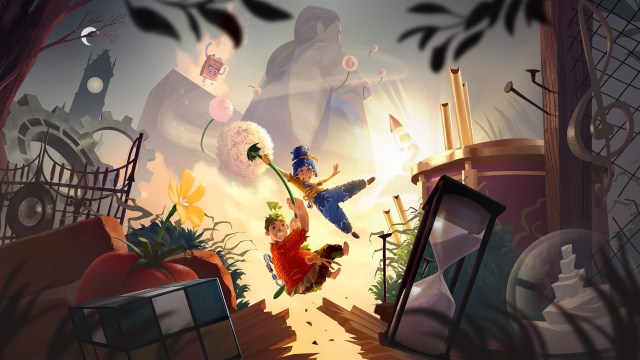
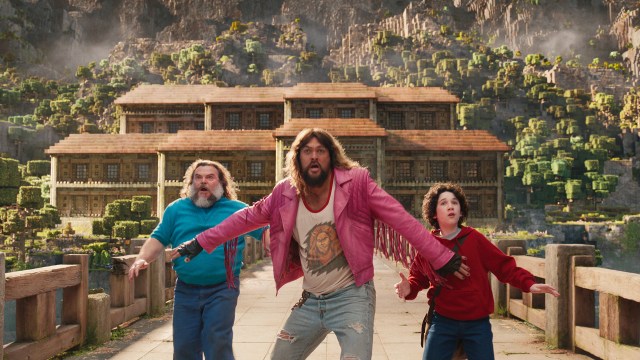
As for It Takes Two‘s film reimagining, it’s been over four years since Dwayne Johnson’s Seven Bucks production team boarded the Amazon-led project. Speaking to Eurogamer last March, Hazelight creative director Josef Fares, who’s known for not mincing his words, took aim at how long it was taking for the film to move forward.
“Hollywood, there’s so much b******t,” Fares responded when asked for an update. “I think 90 percent of the meetings are actually b******t, and 10 percent are what actually happens. There’s a lot of talk, but not a lot of walk. I don’t know what’s going on. Hopefully something. It would be cool to get something out of it, but my hopes are not so high.”
“They are,” Johnson says when I ask him if Fares, Hazelight, and Johnson’s company are still involved, before he adds: “We’re so close to the Hazelight boys at this point that there’s a shorthand with them, and the relationship with them and partners on our side… it’s all very fluid.”
Days of future past

That’s just the tip of the iceberg when it comes to the 30+ film and TV projects that Story Kitchen plans on delivering.
Johnson and Goldberg want to cover as many genre bases and demographics as possible, too. Film adaptations of three Roblox games — Grow a Garden, Steal a Brainrot, and Jailbreak — are in the works, as are Just Cause, Shinobi, and Ruiner productions with Universal.
Elsewhere, Netflix has signed on to bring Sifu and Kingmakers adaptations to its user base, Lionsgate is hard at work on a Streets of Rage movie, and film reimaginings of hit indie games Disco Elysium and Dredge have also been announced. Additionally, a House of the Dead movie led by The Last of Us and Superman star Isabela Merced — “she’s our homie,” Johnson beams —is just another of Story Kitchen’s other planned projects.
I think it’s going to go the same way as Barbie
Dmitri Johnson
It isn’t just video games that are being turned into movies, either. Toys ‘R Us, a popular toy retailer in the ’80s and ’90s that’s recently enjoyed a resurgence in the US, is getting the live-action film treatment. Meanwhile, Teddy Ruxpin, an animatronic storytelling bear that was a US bestseller in the ’80s, will star in a feature that’s been described as ‘Sonic the Hedgehog meets Elf‘.

“I think it’s going to go the same way as Barbie,” self-confessed Teddy Ruxpin fan Johnson says in reference to the 2023 megahit starring Margot Robbie and Ryan Gosling. “I went into that thinking ‘ugh, cash grab’ and then had a little tear in the eye by the third act.
“It [the Teddy Ruxpin movie] is funnier than it has any right to be,” Johnson continues. “We have ridiculous musical numbers when we shouldn’t, and it’s so brilliantly bananas that it works. I think it’s going to catch people off-guard, and kids are gonna walk out of it wanting a Teddy Ruxpin.”
We’re about to pitch a show based on a game that hasn’t even been announced
Mike Goldberg
But, back to the games — and, perhaps most importantly, Story Kitchen’s mission to create films and TV shows not only based on beloved titles from the past and those that are currently popular, but also those yet to be released.
“We’re about to pitch a show based on a game that hasn’t even been announced,” Goldberg teases as an example of the latter. “And, should nothing change, it’ll finally be announced at the 2026 Game Awards. But we’re already going to take a fully fleshed, packaged, and scripted drama TV pitch on it to studios next month, so we can move as swiftly as possible once the game is officially revealed.”

Whatever that soon-to-be-announced game is, its developer will surely hope it performs as well as 2025 surprise hit Clair Obscur: Expedition 33 did.
The first-ever title from French studio Sandfall Interactive, Clair Obscur unexpectedly dominated the gaming sphere last year. With over eight million copies sold (as of April 2026) and numerous award wins under its belt, it’s little wonder that this critically and commercially successful title is being turned into a live-action film. As Johnson is keen to point out, though, the Clair Obscur bandwagon isn’t one that Story Kitchen jumped on post-launch.
“As a company, we pride ourselves on not chasing heat,” he explains. “We’re less likely to pursue a game once it’s become an established hit, because we don’t ever want to be seen as those people.
We’re less likely to pursue a game once it’s become an established hit
Dmitri Johnson
“We were actually working with Sandfall as early as 2023,” he continues. “We read almost 600 pages of scripts, had raw music files [to listen to], [and] art to look at, so we fell in love with it before we saw any real gameplay. Obviously, you don’t know how a game is going to perform, so we went into this knowing that it could be a tough sell. Without the massive success it had, it would’ve been an uphill battle [to pitch our movie adaptation to studios]. But, as I said earlier, once the passion kicks in, we don’t take ‘no’ for an answer. We were convinced three years ago that this was something to be excited about, and… that’s all we can say about it right now.”
If there’s one thing I took from my chat with Johnson and Goldberg, it’s this: they genuinely care about what they’re doing. Like, a lot. They don’t phone in their work, nor did they lazily trot out stock responses to my questions. They are completely committed to telling the world that games are not only great, but that their stories are also worth translating and telling in other mediums.

There’s so much more that Story Kitchen wants to accomplish, though. Even with the abundance of productions already on their plate, Johnson and Goldberg have ambitions on adapting even more franchises for the big and small screen. Their dream projects? Mega Man and — surprisingly — Bad Dudes for Johnson, and Nintendo’s iconic sci-fi franchise Metroid for Goldberg.
But such wish fulfillment must wait for another day. As we approach the tail-end of what was supposed to be an hour-long interview, Goldberg reveals that he and Johnson are being summoned by Amazon for a meeting — the contents of which he can’t disclose.
It’s a sign of just how busy the pair have become, but they wouldn’t have it any other way. After all, Story Kitchen is no ordinary passion project — it’s reshaping the multimedia landscape as we know it.
That’s our next mission: proving that videogames are art
Dmitri Johnson
“We were recently looking back on our list of games to consider for last year’s BAFTA Game Awards,” Johnson says, “And there’s one from a tiny Australian team called The Drifter that, after I came across it in 2025, I couldn’t stop gushing about. Anyway, we ended up tracking them down and, in the very first meeting we had with another studio, we were able to find a home for this indie game in the form of a big theatrical movie.
“That wouldn’t have been possible five, six years ago, and that’s why we’re enjoying this moment now. Step one was getting rid of this silly notion that games are cursed. Now, step two, and we say this with a straight face, you’ll see Oscars, Emmys, and BAFTAs being won by movies and TV shows that are based on games. That’s our next mission: proving that videogames are art. The stories being told, the characters they contain… they’re no different to a New York Times best-selling book — and we’re ready to show the world why.”

Follow TechRadar on Google News and add us as a preferred source to get our expert news, reviews, and opinion in your feeds.

“It is easier, but it’s not easy,” Story Kitchen co-founder Dmitri Johnson interjects. I’m midway through an in-depth conversation with Johnson and business partner Mike Goldberg about their pioneering entertainment company when the former clarifies something he alluded to earlier. The topic in question? Pitching movies and TV shows based…
