Tennis star Alexander Zverev calls out automated line judging system

It’s clay court season in tennis, and instead of questioning the judgments of chair umpires, some players are now questioning the decisions of complex software — specifically electronic line-calling (ELS) systems, which are increasingly tasked with determining whether a ball is in or out.
German tennis star Alexander Zverev became the latest to dispute the technology after it called his opponent’s ball “in” during a Madrid Open match against Alejandro Davidovich Fokina, as reported earlier by The Athletic. Zverev pointed to the discrepancy between the ELS call and the ball’s mark, which appeared just outside the court’s white line.
Whereas on hard and grass courts, the other surfaces tennis players compete on, clay is unique because it is composed of loose particles of brick and stone. It also means that when a ball strikes a clay court, it leaves a mark of where it bounced. This is often used as clear and indisputable evidence of whether a ball was in or out. So what happens when the automated line-calling software disagrees with the visible mark left by a ball on clay?
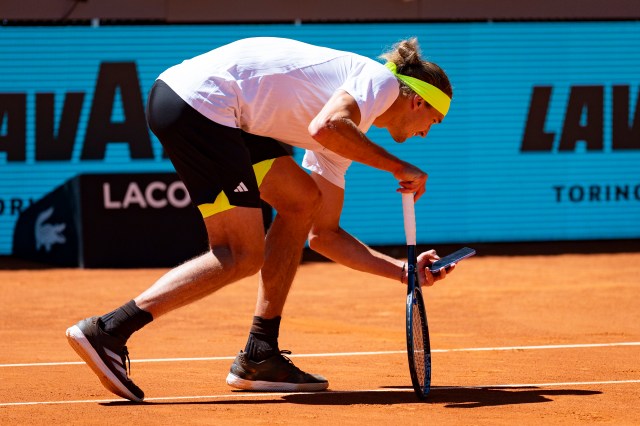
“The machine is not working,” Zverev said to the chair umpire. “Look at this mark… please come down.” He pulled out his phone to snap a photo of the mark and post it on Instagram, resulting in a warning for unsportsmanlike conduct. Other players have snapped photos of disputed shots during the tournament, too, including Victoria Azarenka and Eva Lys.
Though ELS is generally popular with players, we’ll likely see more disputes this year, as the Association of Tennis Professionals (ATP) continues replacing human line judges with ELS across major tournaments (with the French Open, the sole clay Grand Slam, being the only exception).
Hawk-Eye, one of the companies behind this technology, uses a set of cameras to predict where a ball is headed by analyzing its speed, spin, and skid with a three-millimeter accuracy. “The system assumes where a ball will bounce before it arrives, a prophecy of the future made with the confidence of the combined might of physics, surveillance technology, and an algorithm trained on billions of data points,” my colleague Kevin Nguyen writes in a deep dive on the system.
Hawk-Eye announced last year that its live line-calling system is ready for clay courts, where line judges and umpires have long used physical ball marks to make calls. But the look of the ball’s mark may change based on whether the clay is wet or dry, as well as if there is more or less clay on a court, as detailed in this video from the ATP Tour. That could make some of these marks deceiving to the human eye.
“Clay is a very different surface — probably the most difficult surface to work on,” ATP supervisor Cedric Mourier, said in an interview last year. “Interpreting a mark is subjective, the reading of the mark very complicated. And this will be obviously, taken away by the ELS live.” How the player reacts to the system’s determination will just add to the clay court drama.
It’s clay court season in tennis, and instead of questioning the judgments of chair umpires, some players are now questioning the decisions of complex software — specifically electronic line-calling (ELS) systems, which are increasingly tasked with determining whether a ball is in or out. German tennis star Alexander Zverev became…
