Survey says most Gen Z-ers would marry an AI, but I’ve got more faith in Gen Z

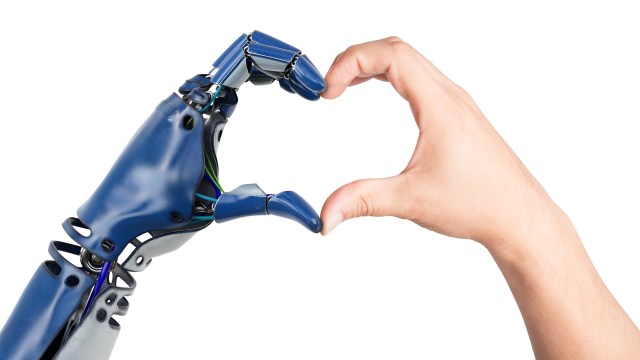
AI-lationships is the gag-inducing term Joi AI cooked up to support its recent eye-opening survey on human-to-AI relationships. In it, eight out of 10 Gen Z respondents said they would consider marrying an AI partner.
Before we delve too much into this mind-bending stat, let’s look at the source. Joi AI, formerly EVA AI, is a premium online AI companion service that offers a wide range of AI companion personalities, complete with AI-generated imagery that can be, depending on settings and what you pay, NSFW.
It’s kind of a cheesy service that caters mostly, I think, to lonely men. Now, don’t get me wrong; I know there’s a growing epidemic of loneliness. A recent Harvard study found that 21% of US adults report some level of loneliness (some studies suggest the number is far higher).
Disconnection
Remote work, screen time, and other things that take us away from direct human connection are probably not helping this trend, but AI has increasingly stepped into the connection void with a growing army of voice chatbots that can carry on surprisingly realistic and even empathetic-sounding conversations.
And this is by design. Earlier this month, Meta CEO Mark Zuckerberg, whose company is building powerful AI models, suggested we should all have AI friends.
Marriage, then, is perhaps, the next logical extension.
The concept of deep, personal relationships between humans and artificial intelligence traces back to well before we had Gemini Live, ChatGPT, Copilot, and others ready and willing to converse with us at length. The 2013 movie Her was built around the idea of a deeply personal (and concerning) relationship between Joaquin Phoenix’s character and Scarlett Johansson’s disembodied AI voice long before we could talk to a single AI in real life.
I’ve had my share of AI conversations, and I find them entertaining and, often, illuminating. I don’t see them as personal, though. Perhaps that’s because I’m not lonely. The more desperate you are for human connection, the more AI companionship might seem like a reasonable substitute.
But marriage?
Meet-cute in the cloud
At least Joi AI adds static imagery to the playful banter you’ll find through its AI partners, but that’s the exception and not the rule. Most generative AI chatbots are just voices and undulating screens. You need images and, ultimately, touch to make a genuine connection… don’t you?
As I write this, I’m reminded that I met my wife through a phone call and that I was enchanted, initially, by nothing but her voice and wit. But to build our relationship and eventual union, we did date in person. Being with her sealed the deal and made me want to marry her.
I don’t understand why Joi AI’s respondents, even Generation Z, who are much more deeply immersed in technology, social media, and AI than any generation before it, would accept an AI as a life mate. In the survey, though, they do sound primed for AI connection, with 83% saying they “could build a deep emotional bond with an AI partner.”
One expert I spoke to via email, Dr. Sue Varma, a board-certified psychiatrist and author of Practical Optimism, put it in perspective for me. “At our core, we all want the same things: to be seen, to be heard, and to feel valued – not judged or criticized. For Gen Z, that longing is especially strong, and the loneliness they’re experiencing is very real. What they want, what we all want, is meaningful, mutual human connection.”
Unconvinced that Joi AI’s data points to a real trend (I did ask them for survey details and have yet to receive a response), I ran a couple of anecdotal surveys on X (formerly Twitter) and Threads. Across both, less than 10% said yes, they would consider marrying an AI, roughly a third said no on Threads, and the vast majority wondered if I was okay.
As preposterous as I find the whole idea of AI relationships and eventual marriage, I also understand that we’re at the start of a revolution. AI’s ability to mimic human language and even emotions is growing exponentially, and there’s already growing concern about human-to-AI relationships.
“Technology—and AI in particular—isn’t going away. It’s going to keep evolving, and yes, it may offer relationships that seem easy, even comforting. Think of the always-affirming AI: the hype person, the yes-person, the one that never challenges us and always tells us what we want to hear. It’s seductive. But it’s not real,” said Dr. Varma, and added, “What we really need to be doing is using AI to support our humanity, not replace it.”
The latest Gemini and ChatGPT models provide incredibly human- and expressive-sounding conversations. Some believe AIs have already beat the Turing test (basically when a computer’s response is indistinguishable from a human’s, at least as perceived by another human).
We will, in this decade, see humanoid robots equipped with these AIs, and that’s when things will get really weird. How long before some dude is marrying his AI bot in Vegas?
Joi AI’s self-serving survey is ridiculous on the face of it, even if it is also a harbinger of AI relationships to come – and I hope Gen Z swipes left on the whole idea.
You might also like
AI-lationships is the gag-inducing term Joi AI cooked up to support its recent eye-opening survey on human-to-AI relationships. In it, eight out of 10 Gen Z respondents said they would consider marrying an AI partner. Before we delve too much into this mind-bending stat, let’s look at the source. Joi…
