Startup wants to mitigate risk of state-actor underwater fibre optic cable sabotage by using a decades-old technique

- Distributed acoustic sensing detects disturbances in fibre optic signals to identify underwater threats
- NATO’s ‘Baltic Sentry’ mission enhances subsea security, but surveillance remains difficult
- AP Sensing’s North Sea deployment highlights fibre optics’ role in security
Subsea fibre optic cables are a crucial part of global internet infrastructure, yet recent damage incidents in the Baltic Sea have raised concerns about their security.
Per the BBC, there are now efforts to mitigate the risk of sabotage by using a decades-old technique known as distributed acoustic sensing (DAS).
This approach detects disturbances in fibre optic signals by capturing tiny reflections sent back along the strands due to pulses from light encountering vibrations or temperature changes, allowing the system to identify suspicious activity such as underwater drones, vessels dragging anchors, or divers near critical cables.
You may like
How fibre optics can ‘listen’ for threats
As with network security, where businesses rely on the best small business routers to prevent cyber threats, monitoring solutions for subsea infrastructure are becoming essential in safeguarding global communications.
Lane Burdette, a research analyst at TeleGeography, notes that the number of faults affecting subsea cables each year has remained steady, typically between 1 and 200. “Cables break all the time…The number of cable faults per year has really held steady over the last several years.”
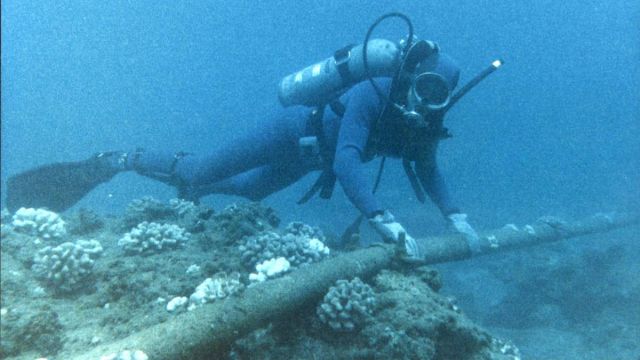
During tests conducted by AP Sensing, the system detected a diver patting a cable on the seabed, while further experiments demonstrated its ability to identify drones and vessels, potentially providing early warnings of sabotage attempts.
“He stops and just touches the cable lightly, you clearly see the signal…The acoustic energy which travels through the fibre is basically disturbing our signal. We can measure this disturbance,” says Daniel Gerwig, global sales manager at AP Sensing, a German technology company.
Just as businesses depend on the best business smartphones for real-time alerts and security updates, early warning systems for subsea cables can provide critical intelligence to prevent disruptions.
Concerns over the vulnerability of these cables have led NATO to launch “Baltic Sentry,” a mission using warships, drones, and aircraft to monitor activity in the region, but since constant surveillance is not always possible, demand for fibre optic acoustic sensing solutions is growing.
“It’s good that Nato and the European Union have woken up…The question is how quickly you could establish contact with a vessel,” said Thorsten Benner, co-founder and director of the Global Public Policy Institute.
Maintaining secure communications in this environment requires the same level of reliability as the best network switches, ensuring smooth data flow and minimal disruption.
Companies such as Optics11 and Viavi Solutions are seeing increased interest in their monitoring technology, which can be deployed on military submarines or along key underwater infrastructure routes.
AP Sensing’s system is already in use in parts of the North Sea, but the technology has limitations, requiring signal interrogation points at regular intervals along the cable and having a sensing range of only a few hundred metres, meaning it can detect nearby threats but is not a complete security solution on its own.
You may also like

Distributed acoustic sensing detects disturbances in fibre optic signals to identify underwater threats NATO’s ‘Baltic Sentry’ mission enhances subsea security, but surveillance remains difficult AP Sensing’s North Sea deployment highlights fibre optics’ role in security Subsea fibre optic cables are a crucial part of global internet infrastructure, yet recent damage…
