Seagate teams with Nvidia to build an NVMe hard drive proof of concept, more than 3 years after its last effort

- Seagate has debuted a new NVMe hard disk proof of concept
- Prototype system pairs NVMe HDDs, SSDs, DPUs, and AIStore for AI workloads
- NVMe HDDs use less power, with better efficiency, and reduced storage costs
In late 2021, Seagate unveiled a proof-of-concept hard disk drive that used the NVMe protocol and a PCIe interface – two technologies typically reserved for solid state drives.
Demonstrated at the Open Compute Project Summit in a custom JBOD enclosure with twelve 3.5-inch drives, the NVMe HDD featured a proprietary controller that supported SAS, SATA, and NVMe natively, without the need for a bridge.
Seen as a way to simplify data center infrastructure by unifying storage devices under a single interface, the drive promised performance improvements, lower TCO, and considerable energy savings.
You may like
Combined
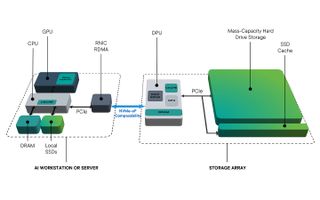
Fast forward to GTC 2025, and Seagate has demonstrated a new proof-of-concept system combining NVMe HDDs and SSDs with Nvidia’s BlueField 3 DPU and AIStore software to show how NVMe can help address common storage challenges in AI environments.
While other vendors are reportedly exploring similar such concepts, Seagate appears to be the only firm showing off a functional system.
Working with customers and partners
“Unlike SAS/SATA-based hard drives, NVMe hard drives remove the need for HBAs, protocol bridges, and additional SAS infrastructure, making AI storage more streamlined,” Seagate says.
“These drives allow AI workloads to scale seamlessly by integrating high-density hard drive storage with high-speed SSD caching in a unified NVMe architecture.”
The prototype Seagate showcased featured eight NVMe hard drives, four NVMe SSDs for caching, Nvidia BlueField DPUs, and AIStore software, all housed inside a hybrid array.
The team demonstrated that direct GPU-to-storage communication, via NVMe hard drives and DPUs, reduced latency in AI workflows. Eliminating legacy SAS/SATA overhead also simplified system architecture and improved storage efficiency.
“By using NVMe hard drives alongside SSDs, organizations will be able to optimize cost while maintaining performance, reserving SSDs for active datasets and using hard drives for long-term AI training data retention,” Seagate says.
From a design perspective, adding NVMe to HDDs potentially only requires a few changes, such as a PCIe interface and firmware updates, while retaining the familiar 3.5-inch form factor.
Compared to SSDs, Seagate says NVMe hard drives offer 10 times more efficient embodied carbon per terabyte, four times more efficient operating power consumption per terabyte, and lower cost per terabyte.
When, or indeed if, these drives will reach the market is anyone’s guess. Seagate says it is “working with customers and partners to explore how NVMe hard drives can fit into next-generation AI storage solutions,” but there’s no timeline for it as yet.
You might also like
Seagate has debuted a new NVMe hard disk proof of concept Prototype system pairs NVMe HDDs, SSDs, DPUs, and AIStore for AI workloads NVMe HDDs use less power, with better efficiency, and reduced storage costs In late 2021, Seagate unveiled a proof-of-concept hard disk drive that used the NVMe protocol…
