Samsung’s rival has debuted new storage tech that offers a super-fast, high-capacity flash memory for ultra-portable devices; Kioxia’s UFS QLC promises to reach speeds of 4.2 GB/s

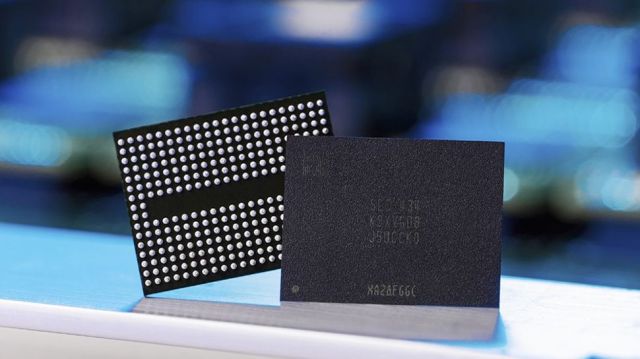
- New QLC technology boosts storage capacity and performance
- High-Speed Link Startup Sequence reduces initialization time by 70%
- Enhanced security features protect sensitive user data effectively
The growing demands of mobile technology have increased the need for high-capacity and high-speed data storage, and as digital devices continue to advance, the industry seeks a way to handle larger data loads while delivering fast and efficient performance.
Kioxia has now launched the mass production of its latest innovation: the industry’s first QLC UFS 4.0 embedded flash memory device.
The new device is designed with quadruple-level cell (QLC) technology and comes with a higher bit density and increased storage capacity thanks to Universal Flash Storage (UFS) technology.
High-speed performance for demanding applications
With this new QLC UFS 4.0 device, Kioxia offers higher storage capacity within a compact structure which not only benefits compact devices like mobile phones and tablets but also PCs, networking systems, and emerging fields like AR, VR, and AI that require robust storage solutions.
Kioxia’s QLC UFS 4.0 device has impressive data transfer rates with the device reaching sequential read speeds of up to 4,200 MB/s and sequential write speeds of up to 3,200 MB/s. These speeds are achieved by utilizing the UFS 4.0 interface, which supports interface speeds as high as 23.2 Gbps per lane or 46.4 Gbps per device.
This combination of QLC storage with the latest UFS interface technology provides a significant performance boost, making it well-suited for data-heavy applications. As a result, users can expect faster file transfers, smoother streaming, and more efficient multitasking, particularly for mobile and high-performance computing devices.
Kioxia’s new QLC UFS 4.0 device is also built on its proprietary BiCS FLASH 3D flash memory, known for its durability and efficiency. Designed to meet the JEDEC standard, the UFS 4.0 package combines this advanced memory with a dedicated controller to optimize performance. With backward compatibility with UFS 3.1, Kioxia’s UFS 4.0 devices offer an upgrade path for users.
To enhance its practical application, Kioxia’s QLC UFS 4.0 device features a High-Speed Link Startup Sequence (HS-LSS), a new method that accelerates device-to-host initialization. By allowing link startup at a faster HS-G1 Rate A rather than the conventional slower speed, HS-LSS reduces link startup time by about 70%.
In addition to faster initialization, the device also includes enhanced security capabilities with Advanced Replay Protected Memory Block (RPMB) features. These security measures protect user data by securing access to sensitive information, such as credentials. With RPMB Purge, users can also ensure that discarded data is fully sanitized, adding another layer of confidence in data protection.
Furthermore, Kioxia’s QLC UFS Ver. 4.0 device supports an Extended Initiator ID (Ext-IID), which is designed to work with Multi Circular Queue (MCQ) in the UFS 4.0 host controller. This feature boosts random performance, a critical component for devices requiring fast and distributed access to data across multiple applications. With Ext-IID, the device is better equipped to manage complex data tasks, providing faster, more efficient performance for users with demanding workloads.
Via BusinessWire
You might also like
New QLC technology boosts storage capacity and performance High-Speed Link Startup Sequence reduces initialization time by 70% Enhanced security features protect sensitive user data effectively The growing demands of mobile technology have increased the need for high-capacity and high-speed data storage, and as digital devices continue to advance, the industry…
