Redwood Materials is giving old EV batteries a second life as microgrids

Redwood Materials is repurposing old EV batteries into energy storage systems that cost “substantially less” than brand new storage projects, the company said Thursday.
The electric vehicle battery recycling and manufacturing venture, which was founded by Tesla’s former chief technologist, has created a new division called Redwood Energy to manage these projects. The aim is to divert “depreciated but functional” EV batteries from the recycling stream and repurpose them into “low-cost, large-scale” energy storage systems that can help plug critical gaps in the energy grid.
Redwood says it receives over 20 GWh of batteries annually — the equivalent of 250,000 EVs— which represents about 90 percent of all lithium-ion batteries and battery materials recycled in North America. And often times, the batteries it receives for recycling still have a lot of usable energy capacity — up to 50 percent. These are batteries that are no longer suitable to power an electric vehicle, but still have enough life in them to serve some purpose.
So rather than recycle those still functional batteries, Redwood is turning them into stationary storage systems. And the company says this will be a growing opportunity as more EV batteries reach the end of their lifespan. Redwood estimates that more than 100,000 EVs will come off the road this year alone.
After recovering the battery packs, Redwoods engineers perform a diagnostics check to determine whether its a suitable candidate for recovery or recycling. If its reusable, the pack is installed into “flexible, modular storage systems” which can operate independently or connect to the grid. Redwood says it has “over a gigawatt-hour” of reusable batteries in its pipeline, a number it expects to grow by 5 GWhs in the coming year.
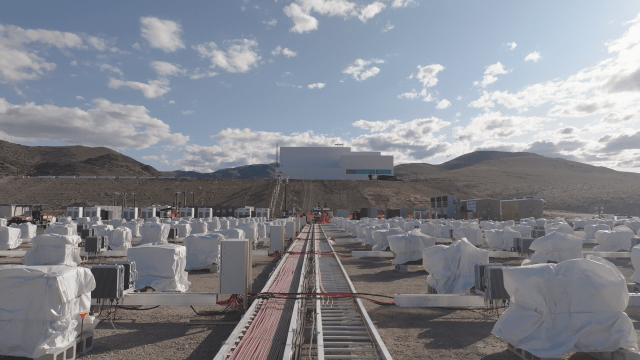
Redwood has already deployed its first microgrid powered by upcycled EV batteries. The grid, with 12 MW of power and 63 MWh of capacity, is located at the company’s campus in Nevada and is being used to power a 2,000-GPU modular data center for AI infrastructure company Crusoe. Redwood calls it the “largest second-life battery deployment in the world” with enough energy to power “9,000 homes, support 20 Amtrak trips between New York and Washington, D.C., or charge an EV for a 240,000-mile journey—the distance to the moon.”
Redwood Materials was founded in 2017 by JT Straubel. In addition to breaking down scrap from Tesla’s battery-making process with Panasonic, Redwood also recycles batteries from Ford, Toyota, Nissan, Specialized, Amazon, Lyft, Rad Power Bikes, Lime, stationary storage facilities, and others. The company also produces anodes and cathodes, critical battery components, at a facility in South Carolina.
Redwood Materials is repurposing old EV batteries into energy storage systems that cost “substantially less” than brand new storage projects, the company said Thursday. The electric vehicle battery recycling and manufacturing venture, which was founded by Tesla’s former chief technologist, has created a new division called Redwood Energy to manage…
