Pushy checkout screens are helping ‘tipflation’

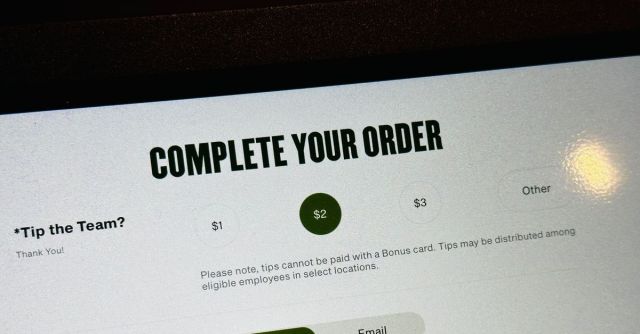
Tipping is an age-old American debate. How much do you pay and when? Is it a choice or an obligation? Generally, tech has at least made it easier over the years. Smartphones made it a breeze for friends to whip out a calculator to figure out tip and split the bill. And now, checkout screens everywhere, from in-person stores to delivery apps, have added buttons designed to make it easier for you to tip.
That’s convenient, until it’s not. According to a new Pew Research Center report, tipping culture in America has seen a shift in recent years. Seventy-two percent of Americans say tipping is expected in more places than five years ago. Not all of that is tech-related, but it’s hard to deny the role checkout screens have in tipflation. Even the Pew Research report notes the practice of tipping “is undergoing significant structural and technological changes,” including “the expansion of digital payment platforms and devices that encourage tipping.”
On days I go to the office, I occasionally treat myself to a latte at a local coffee shop. It’s all good, until I’m paying. A part of me dies at the fact a small latte is now around $9 in Manhattan. The anxiety seeps in when, after I’ve tapped my card against the terminal, it asks me how much I want to tip — 20 percent, 25 percent, and a higher number that I’ve blocked from my memory. There’s an option to not tip or to enter a custom tip, but those are smaller, and pressing those buttons fills me with anxiety that I’m a bad person.
Most recently, a finance bro behind me sighed because I was taking too long to figure out the custom tip interface. I ended up pressing the 25 percent button in a social anxiety-induced panic. Or $11.25. At that price, I regretted the latte, and in my head, I heard Suze Orman’s specter haranguing me for having my millennial treat.
Self-service kiosks occasionally ask me if I want to tip, too. The audacity to even ask is staggering. And even if most people pick “no tip” in that scenario, muscle memory and social programming may mean someone accidentally does tip.
How much of these tip prompts actually goes to the people you intended to tip?
Screens make all this easy partly because it cuts out the math. You just press a button that automatically adds on a percentage or, sometimes, a dollar amount. It’s all built into the regular flow of checking out, and you don’t have to rummage through your wallet to add to the tip jar. The thinking — whether it’s about how much you can afford or how it affects your total — is meant to go out the window. It’s similar to online or in-app shopping — just press the button and move on.
It’s common knowledge that service workers generally prefer direct tips — either handed to them or sent via Venmo. But where does that fit now that cashless payment options and checkout tip prompts are more commonplace? It’s very easy for a business to add these checkout screens to their systems and to set the lowest “easy” option at a price that may be higher than you want to give. They also often make it harder for you to choose an alternative to the preset options. On these screens, the “no tip” or custom options are either smaller or lower down on the menu. And while no one is forcing you to do anything, there’s a gentle persuasion happening that doesn’t always feel right. With DoorDash, if you don’t pre-tip, you now get a warning that your food may be delayed. That makes sense if you view tipping to be an obligation rather than a choice — but for those who view tipping as a reward for good service, it can feel like extortion, too.
Wherever possible, I still try to tip in cash. At my local ice cream shop, it warmed my heart this past summer to stick my dollar in a jar labeled “Help me fund my study abroad to Italy.” It felt a lot better than a digital prompt.
Tipping is an age-old American debate. How much do you pay and when? Is it a choice or an obligation? Generally, tech has at least made it easier over the years. Smartphones made it a breeze for friends to whip out a calculator to figure out tip and split the…
