Nvidia’s entry level GPU can handle 66 million pixels, enough to feed two 8K monitors — but it is its tiny 70W power consumption that will get jaws dropping

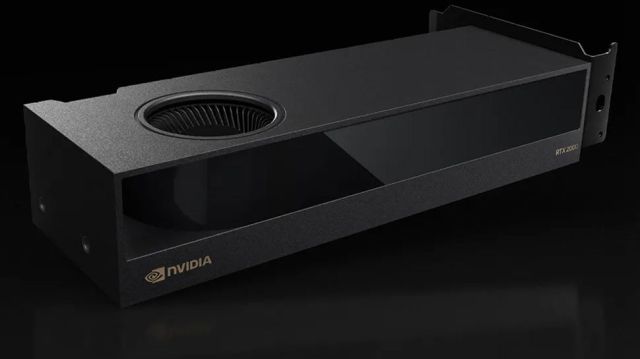
Nvidia has unveiled the RTX 2000 ADA Generation, a powerful yet energy-efficient addition to its workstation GPU lineup. As you can guess from the name, it’s built around Nvidia’s cutting-edge Ada Lovelace architecture, meaning users benefit from third-generation RT Cores, fourth-generation Tensor Cores, CUDA cores, and AV1 encoders.
The seventh SKU in Nvidia’s workstation GPU series is centered around the AD107 GPU, and reportedly delivers up to 1.5x the performance of its predecessor, the RTX A2000, in professional workflows. It’s particularly well suited for fields like 3D modeling, rendering, data visualization, and video streaming.
Nvidia says the RTX 2000 ADA also has potential in embedded applications and edge computing, where it can power real-time data processing for medical devices, optimize manufacturing processes, and enable AI-driven intelligence in retail environments.
70 watts
RTX 2000 ADA Generation’s low-profile, small form factor means it doesn’t need external power connections, and only requires a maximum of 70 watts of power to run. It comes with 16GB of GDDR6 of graphics memory, which is more than was rumored when we first heard about it, and 4GB more than the RTX A2000.
The new GPU is equipped with four Mini DisplayPort 1.4a ports, enabling it to support four 4K screens at 120Hz, or two 8K displays at 60Hz. However, if your requirements include DisplayPort 2.0/2.1 compatibility, this GPU isn’t for you.
Highlights of the new card include:
- Third-generation RT Cores: Up to 1.7x faster ray-tracing performance for high-fidelity, photorealistic rendering.
- Fourth-generation Tensor Cores: Up to 1.8x AI throughput over the previous generation, with structured sparsity and FP8 precision to enable higher inference performance for AI-accelerated tools and applications.
- CUDA cores: Up to 1.5x the FP32 throughput of the previous generation for significant performance improvements in graphics and compute workloads.
- Power efficiency: Up to a 2x performance boost across professional graphics, rendering, AI and compute workloads, all within the same 70W of power as the previous generation.
- Immersive workflows: Up to 3x performance for virtual-reality workflows over the previous generation.
- 16GB of GPU memory: An expanded canvas enables users to tackle larger projects, along with support for error correction code memory to deliver greater computing accuracy and reliability for mission-critical applications.
- DLSS 3: Delivers a breakthrough in AI-powered graphics, significantly boosting performance by generating additional high-quality frames.
- AV1 encoder: Eighth-generation NVIDIA Encoder, aka NVENC, with AV1 support is 40% more efficient than H.264, enabling new possibilities for broadcasters, streamers and video callers.
The Nvidia RTX 2000 Ada is available now, priced at $625.
More from TechRadar Pro
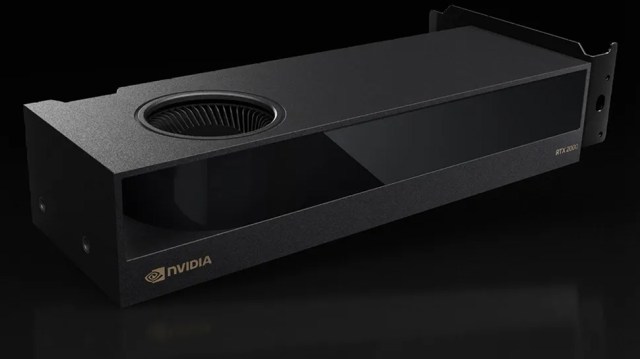
Nvidia has unveiled the RTX 2000 ADA Generation, a powerful yet energy-efficient addition to its workstation GPU lineup. As you can guess from the name, it’s built around Nvidia’s cutting-edge Ada Lovelace architecture, meaning users benefit from third-generation RT Cores, fourth-generation Tensor Cores, CUDA cores, and AV1 encoders. The seventh…
