NASA’s Psyche mission fires up its futuristic electric engines

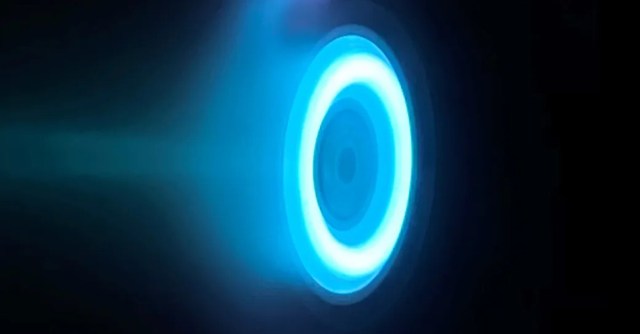
NASA has turned on the electric Hall thrusters of Psyche, a spacecraft that’s now gently motoring toward a metal-rich asteroid embedded in the main asteroid belt beyond Mars. The agency says Psyche is in “full cruise” mode now, six months after launching on October 13th, 2023, on a conventional, SpaceX rocket.
On the way, NASA used Psyche to test laser-based deep space communications. The craft shot a communications laser back at the Earth from close to 10 million miles out, which is a first for NASA. It’s expected to reach its target and namesake, the Psyche asteroid, by 2029 and will orbit it for two years, observing and sending data back to NASA. Scientists suspect Psyche is actually the beginning core of a planet, also called a planetesimal.
Ion propulsion is both relatively new and pretty old for NASA. The agency has been working on the tech since before US astronauts first flew to the Moon, having test-fired its first ion thruster in 1964. They also have no moving parts; instead, they generate thrust by exciting xenon particles, pushing them out of the thruster. You can read more about them in this NASA paper (PDF) describing ion propulsion.
There are lots of different kinds of ion propulsion, including the magnetic Hall thrusters used by Psyche. In 2018, Psyche’s Spacecraft Chief Engineer wrote this detailed explanation of the differences between those and other ion thrusters, as well as other kinds like arc jets and microwave thrusters.
NASA first used ion propulsion as a spacecraft’s main propulsion for 1998’s Deep Space 1, a mission specifically conducted to test “various advanced technologies for future interplanetary missions.” In 2007, Dawn became NASA’s “first exclusively science-focused” mission to use ion thrusters, flying until it ran out of hydrazine, the fuel it used for its orientation thrusters. Without those, it couldn’t turn itself back to maintain communication with NASA
Ion propulsion isn’t powerful enough to launch a rocket from Earth, but they can still reach very high speeds over time. Right now, NASA says Psyche is traveling at 23 miles per second, or about 84,000mph, and will eventually reach 124,000mph. Thrusters like Psyche’s are generally useful because the lack of moving parts makes them durable, and they use less fuel, so they’re lighter and can be used on smaller spacecraft. Plus, they look cool when they’re turned on.
NASA has turned on the electric Hall thrusters of Psyche, a spacecraft that’s now gently motoring toward a metal-rich asteroid embedded in the main asteroid belt beyond Mars. The agency says Psyche is in “full cruise” mode now, six months after launching on October 13th, 2023, on a conventional, SpaceX…
