My jaw hit the floor when I watched an AI master one of the world’s toughest physical games in just six hours

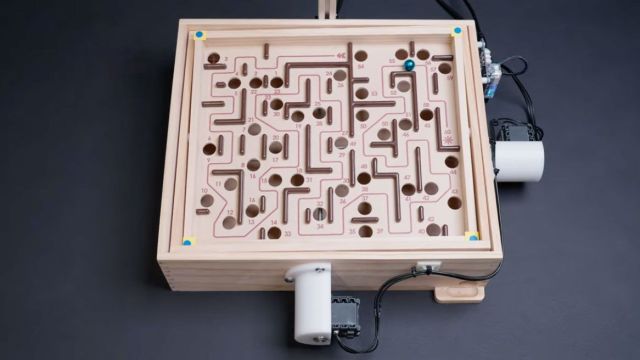
An AI just mastered Labyrinth in six hours, and I am questioning my own existence.
I started playing Labyrinth in the 1970s. While it may look deceptively simple and is fully analog, Labyrinth is an incredibly difficult, nearly 60-year-old physical board game that challenges you to navigate a metal ball through a hole-riddled maze by changing the orientation of the game platform using only the twistable nobs on two adjacent sides of the game’s box frame.
I still remember my father bringing Labyrinth home to our Queens apartment, and my near-total obsession with mastering it. If you’ve never played, then you have no idea how hard it is to keep a metal ball on a narrow path between two holes just waiting to devour it.
It’s not like you get past a few holes and you’re home free; there are 60 along the whole meandering path. One false move and the ball is swallowed, and you have to start again. It takes fine motor control, dexterity, and a lot of real-time problem-solving to make it through unscathed. I may have successfully navigated the treacherous route a few times.
It sometimes ignored the path and took shortcuts. That’s called cheating.
In the intervening years, I played sporadically (once memorably with a giant labyrinth at Google I/O), but mostly I forgot about the game, though I guess I never really forgot the challenge.
Perhaps that’s why my mouth dropped open as I watched CyberRunner learn and beat the game in just six hours.
In a recently released video, programmers from the public research university ETH Zurich showed off their bare-bones AI robot, which uses a pair of actuators that act as the ‘hands’ to twist the Labyrinth nobs, an overhead camera to watch the action, and a computer running an AI algorithm to learn and, eventually, beat the game.
In the video, developers explain that “CyberRunner exploits recent advances in model-based reinforcement learning and its ability to make informed decisions about potentially successful behaviors by planning into the future.”
Initially, CyberRunner was no better than me or any other average human player. It dumped the metal ball into holes less than a tenth of the way through the path, and then less than a fifth of the way through. But with each attempt, CyberRunner got better – and not just a little better, but exponentially so.
In just six hours, according to the video, “CyberRunner’s able to complete the maze faster than any previously recorded time.”
The video is stunning. The two motors wiggle the board at a super-human rate, and manage to keep the ball so perfectly on track that it’s never in danger of falling into any of the holes. CyberRunner’s eventual fastest time was a jaw-dropping 14.8 seconds. I think my best time was… well, it could often take many minutes.
I vividly recall playing, and how I would sometimes park the ball in the maze, taking a break mid-challenge to prepare myself for the remainder of the still-arduous journey ahead. No so with CyberRunner. Its confidence is the kind that’s only possible with an AI. It has no worries about dropping its metal ball into a hole; no fear of failure.
It also, initially, had no fear of getting caught cheating.
As CyberRunner was learning, it did what computers do and looked for the best and fastest path through the maze, which meant it sometimes ignored the path and took shortcuts. That’s called cheating. Thankfully, the researchers caught CyberRunner, and reprogrammed it so it was forced to follow the full maze.
Of course, CyberRunner’s accomplishment is not just about beating humans at a really difficult game. This is a demonstration of how an AI can solve physical-world problems based on vision, physical interaction, and machine learning. The only question is, what real-world problems will this open-source project solve next?
As for me, I need to go dig my Labyrinth out of my parent’s closet.
You might also like

An AI just mastered Labyrinth in six hours, and I am questioning my own existence. I started playing Labyrinth in the 1970s. While it may look deceptively simple and is fully analog, Labyrinth is an incredibly difficult, nearly 60-year-old physical board game that challenges you to navigate a metal ball…
