Microsoft convinced AMD and Nvidia to build a CPU with extraordinary features but it will never go on sale: 4th gen 9V64H has 96 cores and uses InfiniBand technology

Recent updates
An earlier version of the article mentioned that the 9V64H had 88 cores. AMD reached out to confirm that it actually has 96 cores. 8 Cores (1 out of 12) are used as overhead.
- Microsoft has unveiled a custom-designed AMD CPU
- Available only on Azure, it uses ultra-fast HBM memory
- Nvidia’s InfiniBand technology has also been used
Earlier today at Ignite, Microsoft CEO, Satya Nadella, pulled the curtain on a new AMD processor destined to become the most powerful CPU to run on its Azure cloud computing infrastructure, one that comes with a few surprises. You can request a preview access to the Azure HBv5 VMs by filling this form.
The 9V64H is a custom made, 4th generation EPYC server CPU, not one based on the latest 5th generation one, codenamed Turin. It has 88 cores and clocked at up to 4GHz; the closest existing model is the 9634, an 84-core CPU with a top speed of 3.7GHz.
According to Fernando Aznar, HPC + AI Product Marketing Manager at Microsoft, it will focus on “most memory bandwidth-intensive HPC applications, such as computational fluid dynamics, automotive and aerospace simulation, weather modeling, energy research, molecular dynamics, computer aided engineering”. But no word on AI.
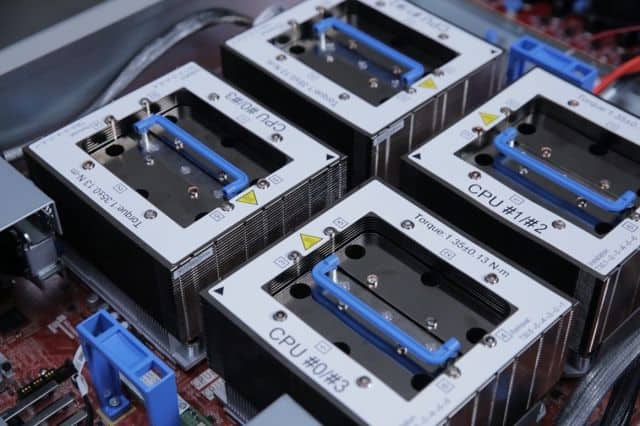
What makes the CPU so special is that a cluster of four of these, as part of Azure HBv5 VMs (set to be launched in 2025), it has access to up to 450GB of RAM, in that case HBM3, with a combined memory bandwidth of nearly 7.0TBps.
That’s more than the AMD Instinct MI300A accelerator sans the GPU part (24 cores, 3.7GHz peak, 128GB HBM memory, 5.3TBps peak performance) and almost an order of magnitude higher than the rest of the competition (including AMD’s own).
A very unique CPU
But there’s more to it: this is AMD first quad-socket project which is an interesting take on what AMD told me earlier this year when I interviewed Robert Hormuth, the company’s corporate vice president, architecture and strategy.
Clearly, single socket is where the market is going, except when there’s a clear case – and a hyperscale client with near unlimited funds – to go for quads.
Microsoft also confirmed that the chip is SMT-disabled (just like the Zen 4c and Zen 5c parts) and the VM will be able to access a staggering 3.17TB of memory (up to 9GB per core).
And while this is a co-engineered chip, Microsoft is firmly at the helm as it enlisted Nvidia, AMD’s archnemesis, to provide with the industry-leading Quantum-2 Infiniband networking technology to keep CPUs fed with bits (800 Gb/s, split evenly between four CPUs).
This Microsoft says, will allow customers to “efficiently scale their workloads to hundreds of thousands of cores” if needed.
I was also intrigued by the mention of a 14TB local NVMe SSD that delivers up to 50GB/s read and 30GB/s write performance, which is far superior to anything out there that uses PCIe Gen5 technology and can only be achieved using specialist hardware like Highpoint’s Rocket 1608A add in storage card.
More from TechRadar Pro

Recent updates An earlier version of the article mentioned that the 9V64H had 88 cores. AMD reached out to confirm that it actually has 96 cores. 8 Cores (1 out of 12) are used as overhead. Microsoft has unveiled a custom-designed AMD CPU Available only on Azure, it uses ultra-fast…
