Mercedes-Benz is going to use Tesla’s EV charging too

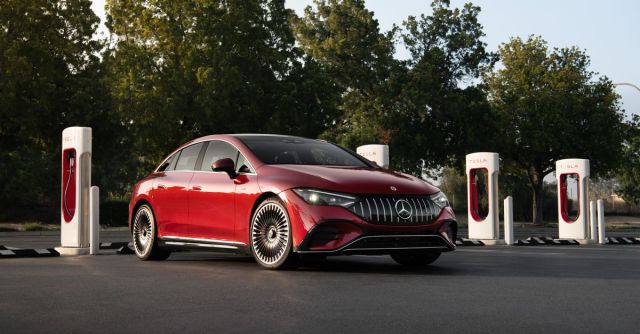
Mercedes-Benz is the latest automaker to commit to adopting Tesla’s electric vehicle charging connectors for its vehicles, bringing Elon Musk’s company one step closer to total EV charging dominance.
Starting in 2024, the German automaker will offer adapters to its customers so they can access Tesla Supercharger stations, which use the company’s North American Charging Standard (NACS) plug and outlet. And in 2025, Mercedes will begin to manufacture EVs with Tesla’s charging port, obviating the need for an adapter.
The company joins Ford, GM, Volvo, Polestar, and Rivian in adopting Tesla’s connector, which is rapidly becoming the de facto charging standard in North America and Europe. Mercedes is also the first German automaker to jump on the Tesla bandwagon, putting pressure on Volkswagen and BMW to follow suit. VW, along with Hyundai, Kia, and Stellantis, has previously confirmed it is in talks with Musk’s company about adopting NACS.
The company joins Ford, GM, Volvo, Polestar, and Rivian in adopting Tesla’s connector
Mercedes also announced it plans on expanding its network of EV charging stations in North America to 400 hubs with more than 2,500 “high-power chargers,” which will also grow to include Tesla’s NACS connector. The company plans on installing 2,000 hubs with 10,000 chargers worldwide.
Mercedes announced earlier this year that it was working with ChargePoint and MN8, a solar company, to install chargers in key cities and along major highways. The first stations, which will be accessible to Mercedes and non-Mercedes EV owners, are scheduled to open in the fourth quarter of 2023.
Tesla’s Supercharger network is widely recognized as superior to many of the third-party EV charging stations, most of which feature Combined Charging System (CCS) plugs and the less utilized CHAdeMO charging standard. The company says it has 45,000 Superchargers worldwide, 12,000 of which are located in the US. According to the Department of Energy, Tesla operates nearly 2,000 DC fast-charging stations in the US as well as almost 5,000 Level 2 chargers.
And while other EV charging stations struggle with software glitches, frayed cables, and broken chargers, Tesla says its Superchargers are nearly perfect in their reliability. The company says that the average uptime of Supercharger sites last year amounted to 99.95 percent, down marginally from 99.96 percent in 2021.
For years, Tesla Superchargers were exclusive to Tesla owners — but that changed when the company started offering access to non-Tesla EVs in Europe. Last year, the Biden administration announced that Tesla would begin to do the same in the US as a prerequisite to tap into some of the $7.5 billion for EV charging in the Bipartisan Infrastructure Law.
Unlike in Europe, Tesla Superchargers in the US use a proprietary connector — this was Tesla’s “competitive moat,” the thing that initially offered protection from other automakers. The NACS connector is smaller than CCS connectors, making it less likely to fail. In order to allow non-Tesla vehicles to access the chargers, the company installed a device called the “Magic Dock” in which a CCS adapter is applied to the connector.
Mercedes-Benz is the latest automaker to commit to adopting Tesla’s electric vehicle charging connectors for its vehicles, bringing Elon Musk’s company one step closer to total EV charging dominance. Starting in 2024, the German automaker will offer adapters to its customers so they can access Tesla Supercharger stations, which use…
