Meet the ‘Duracell Bunny’ of SSDs that can withstand 50 drive writes per day for five whole years – but it won’t come cheap

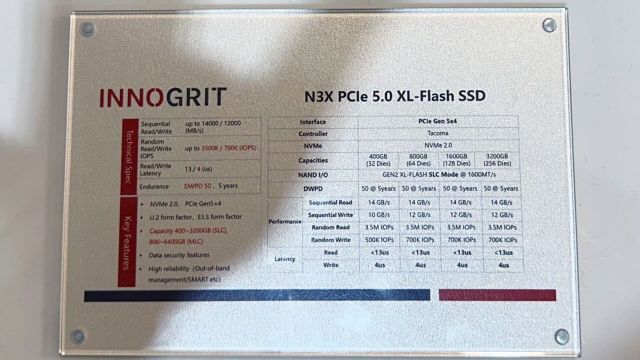
- InnoGrit N3X SSD delivers 50 DWPD endurance but costs more than typical enterprise drives
- Built for caching, inference, and workloads that punish ordinary SSDs
- Runs entirely in SLC mode, sacrificing capacity for serious performance gains
The InnoGrit N3X SSD introduces a high-endurance storage solution aimed at enterprise workloads with extreme write demands.
Unveiled at Computex 2025, and featuring Kioxia’s second-generation XL-Flash operating in SLC mode, the drive is engineered to deliver 50 drive writes per day (DWPD) over five years, far exceeding the endurance of typical enterprise SSDs.
This level of durability is impressive, but it also raises questions about the cost of the device and whether its performance will justify the expected premium.
SCM roots and a specialized architecture
At the heart of the N3X is storage class memory (SCM), a memory tier designed to bridge the performance gap between DRAM and traditional NAND flash.
When used in SLC mode, Kioxia’s XL-Flash functions as a type of SCM, promising ultra-low latency and high endurance.
Unlike standard NAND, which stores multiple bits per cell, operating XL-Flash in SLC mode prioritizes speed and reliability over capacity.
This design choice closely mirrors the original goals of Intel’s now-discontinued Optane memory, positioning the N3X as a potential successor in that specialized niche.
While SCM technologies like XL-Flash are not new, they remain relatively rare due to their high cost and specialized applications.
InnoGrit’s use of the IG5669 PCIe 5.0 controller, with NVMe 2.0 support, allows for impressive performance claims: up to 14 GB/s read and 12 GB/s write speeds, along with 3.5 million random read IOPS.
Latency is where the N3X particularly stands out – read latency under 13 microseconds and write latency as low as 4 microseconds.
If consistently achieved, these figures would place the N3X among the fastest SSDs in development.
The drive is marketed for workloads involving sustained writes, in-memory computing, and real-time inference, areas where traditional NAND SSDs often struggle with latency and wear.
However, the decision to operate entirely in SLC mode significantly reduces the available capacity per die, resulting in smaller drive sizes and a higher cost per gigabyte.
While the drive is offered in capacities ranging from 400GB to 3.2TB, these fall short of what is expected from today’s largest SSDs.
Although the N3X possesses many of the technical qualities of the best portable SSDs, it is not intended for mainstream use.
Its reliance on SCM architecture, while enabling exceptional performance, places it firmly in the domain of niche enterprise deployments.
You might also like
InnoGrit N3X SSD delivers 50 DWPD endurance but costs more than typical enterprise drives Built for caching, inference, and workloads that punish ordinary SSDs Runs entirely in SLC mode, sacrificing capacity for serious performance gains The InnoGrit N3X SSD introduces a high-endurance storage solution aimed at enterprise workloads with extreme…
