L’Oréal claims its new skincare gadget can tell which ingredients work best for you

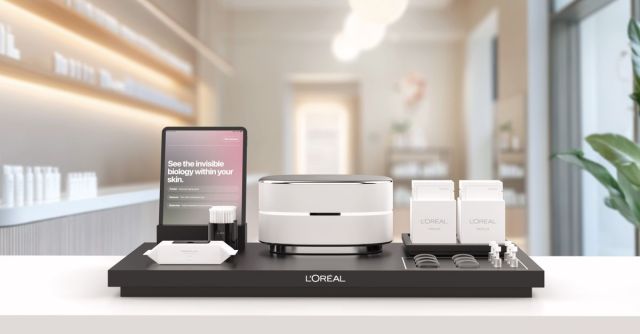
L’Oréal is hoping its latest beauty gadget can demystify skincare. At CES 2025, the company announced Cell BioPrint, a device that’s designed to analyze your skin and give personalized advice on how to slow down signs of aging.
The device is the result of a partnership with NanoEntek — a Korean startup that specializes in chips that can read biofluids. A person essentially takes a facial tape strip, sticks it on their cheek, and then puts the strip in a buffer solution. That solution is then inserted into a cartridge for the Cell BioPrint to analyze. Once that sample is processed, the device takes images of your face as you answer a few short questions about skin concerns and aging.
From there, L’Oreal says it uses proteomics, or the analysis of protein structure and function from a biological sample. In this case, the Cell BioPrint is designed to determine how well your skin is aging. It’ll then give personalized advice on how to improve your skin’s appearance, as well as predictions of how responsive your skin may be to certain skincare ingredients.
It’s an attractive claim, but as with most beauty tech, it’s difficult to properly evaluate L’Oréal’s methods without peer-reviewed studies or experts weighing in. L’Oréal also claims the device can help predict future cosmetic issues before they manifest. For example, it may be able to determine if your skin is prone to hyperpigmentation or enlarged pores.
Skincare became massively popular during covid-19 lockdowns, sparking a shift in beauty trends toward self-care and the rise of “skinfluencers.” On the flip side, that virality has since turned skincare buying into an extreme sport. Hop onto TikTok, and you’ll find dozens of skinfluencers egging you into dropping $80 on a vial of vitamin C serum, debating the moisturizing properties of glycerin versus hyaluronic acid, or wagging a finger about this or that retinol cream. (Some, may even convince you to buy a wand that zaps your face to increase the efficacy of said ingredients.) It’s confusing, expensive, and maddeningly, what works for one person may not for another. The most the average consumer can do is cross their fingers and hope that the latest potion they bought will actually work.
The Cell BioPrint’s appeal is it claims to use science to cut through that noise. Maybe every skinfluencer says you need to start using retinol when you turn 30, but this device will purportedly tell you based on your own biology whether retinol will actually work for you. Personalization has always been a major theme with CES beauty tech, but it’s particularly compelling with skincare, which is highly dependent on your individual biology. But again, right now there’s no way to know how reliable the Cell BioPrint’s science and recommendations are.
L’Oréal says the Cell BioPrint will be easy to use, with the process taking only five minutes. It also says people will be able to repeat tests, enabling them to monitor changes and progress over time. That said, it might be a while before something like Cell BioPrint is available for consumers. L’Oréal says the device will first be piloted in Asia later this year but otherwise didn’t have a concrete launch timeline or price.
L’Oréal is hoping its latest beauty gadget can demystify skincare. At CES 2025, the company announced Cell BioPrint, a device that’s designed to analyze your skin and give personalized advice on how to slow down signs of aging. The device is the result of a partnership with NanoEntek — a…
