LG’s new super-bright OLED panel could give the next Meta Quest an edge over the Apple Vision Pro

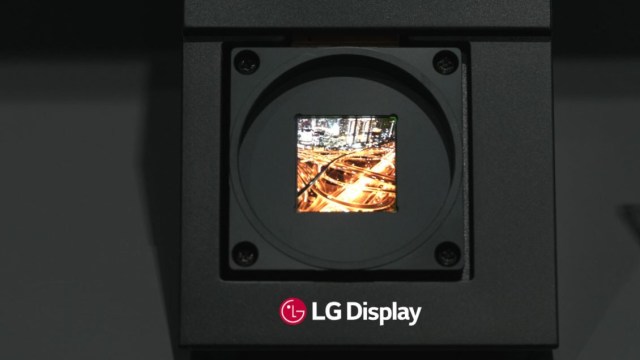
LG Display has unveiled an eye-wateringly bright OLED display that’s specially designed for VR headsets – a 10,000-nit OLEDoS (OLED on silicon) panel that could help to bring Meta headsets more in line with the Apple Vision Pro’s visual superiority.
For context, the Meta Quest 3’s displays offer a mere 100 nits, while Apple’s Vision Pro’s OLEDoS panels are rated to achieve 5,000 nits – though there’s no official word on whether they ever get that bright.
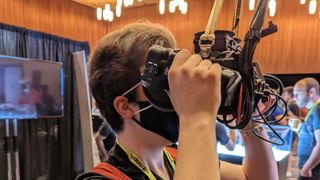
LG’s 10,000-nit screens would blow all of these out of the water, though they’d only be half as bright as the 20,000-nit prototype Meta headset I’ve tested in the past (appropriately called Starburst). The advantage is that these super-bright headsets can deliver much more life-like HDR – meaning darker spaces seem darker, while bright objects truly glow like you’d expect them to in the real world.
It’s worth noting that while LG’s new VR OLED can achieve 10,000 nits, it may not ever get that bright or be that bright frequently. Running at 10,000 nits constantly would likely cause a lot of heat and drain your headset’s battery. Considering it would be so close to your eyes, I’d also be concerned it might cause damage. When I tested Starburst, the highest 20,000-nit setting did slightly sting and most of the scenes demoed in this setting were dark with just a few exceptionally bright columns.
Beyond being über bright, this LG display has an ultra-high 4,000 pixel per inch resolution. That’s over triple the Quest 3’s 1,218 pixel per inch resolution, and LG still beats out the Vision Pro’s 3,386 pixels per inch (via iFixit).
Is LG going to take over XR?
There’s no word yet on when or even if LG’s OLEDoS panel will appear in an actual VR headset that you or I could buy, but if it does feature in a product, we expect it’ll be in Meta hardware first. That’s because LG and Meta have officially teamed up to work on XR technology (a catchall for VR, AR, and MR), and I’m convinced this means LG is making the displays for the next Meta Quest Pro.
However, there is a small chance LG’s VR plans could be more selfish.
That’s because since LG and Meta announced their collaboration, Meta has revealed that its Horizon OS is coming to third-party VR headsets – beginning with Xbox Lenovo, and Asus. LG isn’t on this list but it too may have its own VR headset in the works that would put its OLEDoS panel to use, rather than appearing in an official Meta Quest.
We’ll have to wait and see what’s announced, but whichever VR headset gets this new LG OLEDoS panel it’s almost certainly going to be one of the best VR headsets out there.
You might also like
LG Display has unveiled an eye-wateringly bright OLED display that’s specially designed for VR headsets – a 10,000-nit OLEDoS (OLED on silicon) panel that could help to bring Meta headsets more in line with the Apple Vision Pro’s visual superiority. For context, the Meta Quest 3’s displays offer a mere…
