Japanese scientists close in on petabit-class submarine cable tech set to revolutionize Internet speeds — NEC and NTT managed to shuttle hundreds of terabits over thousands of kilometers thanks to a clever algorithm

To cope with the demand for international bandwidth almost doubling every two years, Japanese corporations NEC and NTT have successfully trialed a revolutionary submarine cable technology set to drastically enhance internet speeds under the sea.
The transoceanic-class experiment transmitted hundreds of terabits across a staggering 7,280km, a feat made possible through a sophisticated algorithm.
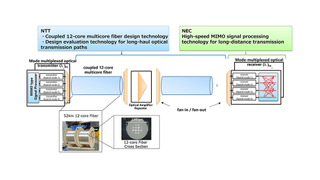
NEC and NTT’s innovative solution uses a 12-core multicore fiber, comprising of 12 optical signal transmission paths within a standard outer diameter optical fiber, a significant enhancement from existing single-core fiber used in submarine cables.
MIMO technology
However, the addition of more cores to an optical fiber presents its own challenges. Interference, or crosstalk, occurs when optical signals leak from one core to another, leading to a degradation in communication quality. This is amplified in long-distance transmission where non-uniformity of delay and loss between signals makes accurate reception difficult.
To overcome these issues, NEC developed an algorithm for demodulating received signals using MIMO technology. This enabled accurate separation and demodulation of high-speed received signals. Concurrently, NTT developed the coupled 12-core multicore fiber optical transmission line which mitigates the effects of non-uniformity in signal delay and loss.
Moving forward, NEC and NTT say they aim to commercialize their research, potentially contributing to the realization of a high-capacity optical submarine cable system and terrestrial core network.
The research team, which recently presented its findings as a highly scored paper at the Technical Conference of OFC 2024 in San Diego, estimates that such systems could operate at hundreds of terabits per second, depending on specific cable designs, potentially heralding the advent of petabit per second class submarine cables.
More from TechRadar Pro

To cope with the demand for international bandwidth almost doubling every two years, Japanese corporations NEC and NTT have successfully trialed a revolutionary submarine cable technology set to drastically enhance internet speeds under the sea. The transoceanic-class experiment transmitted hundreds of terabits across a staggering 7,280km, a feat made possible…
