Humans optional: Tomorrow’s Internet of Agents is being planned today and will bypass homo sapiens almost entirely

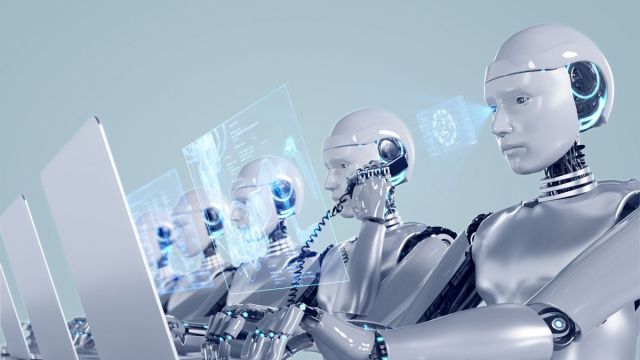
- The Bot-2-Bot paradigm is rapidly turning into an agent-to-agent one
- Network supremo Cisco is at the forefront of this evolutionary inflection point
- Agents will likely have their own language as well, bypassing human lingo
The next frontier of artificial intelligence is unfolding and, worryingly for many, human involvement may not be a central requirement.
Discussions in tech circles are increasingly focused on building a framework where AI agents – autonomous, reasoning machines – collaborate seamlessly to achieve complex tasks independent of human oversight. Dubbed the “Internet of Agents,” this next step could ultimately redefine how businesses and industries operate.
Cisco’s Outshift group is one of the key players tackling the challenges of creating the infrastructure necessary to connect these AI agents.
Droidspeak
The vision is certainly ambitious. AI agents from different companies and organizations should be able to automatically find each other, exchange data securely, and solve problems collaboratively.
“We stand at yet another inflection point – the move to distributed agentic computing,” Outshift’s Vijoy Pandey noted in a recent white paper. He described this as “a platform paradigm shift larger than all other platforms in the past.”
Pandey argues that this Internet of Agents must be “fast, safe, and open,” incorporating advanced hardware-software stacks for low-latency communication and quantum-safe encryption to secure interactions.
The rise of AI-driven “foundation models,” such as ChatGPT, has already accelerated the evolution of AI agents, which go beyond generating text or images to planning, reasoning, and working autonomously. Significant hurdles still remain, of course. Industry-wide cooperation will be needed to establish common protocols, ensure system scalability, and build trust frameworks.
Microsoft researchers are taking a different, yet complementary, approach by addressing communication bottlenecks between AI agents. SingularityHub reports the tech giant has developed “DroidSpeak,” a machine-centric language inspired by the beeps and whistles droids use to communicate in Star Wars. It’s designed to be faster and more efficient than human languages like English.
In a paper published on the arXiv preprint server, Microsoft says, “Experiments on diverse datasets and model pairs demonstrate that DroidSpeak achieves up to 3x higher throughputs and 2.6x faster prefill times with negligible accuracy loss compared to full recomputation.”
Despite the promise, both Cisco and Microsoft acknowledge the road ahead is long. Open standards for cross-compatibility between models and advancements in computational efficiency will be necessary to fully realize an Internet of Agents. However, if successful, and there’s no reason to suspect it won’t be, the concept could create a new era of collaboration, and one in which humans play only a peripheral role.
You might also like
The Bot-2-Bot paradigm is rapidly turning into an agent-to-agent one Network supremo Cisco is at the forefront of this evolutionary inflection point Agents will likely have their own language as well, bypassing human lingo The next frontier of artificial intelligence is unfolding and, worryingly for many, human involvement may not…
