Google will let you control your Chromebook with your face

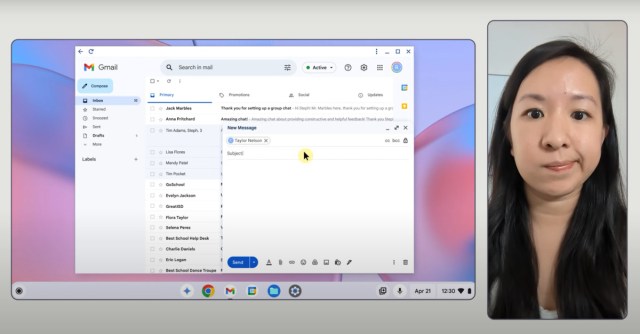
Google is announcing a variety of classroom and accessibility-focused ChromeOS features today, and one of the standouts is being able to control your computer with your head and facial expressions. The feature — aimed at those with motor impairments — was first announced in early December, but it’s now rolling out to more users with compatible Chromebooks (Google recommends 8GB of RAM or more).
This isn’t Google’s first foray into the face-as-a-cursor space. It previously made an open-source AI accessibility tool for Windows games called Project Gameface, which was also announced for Android. Here’s a sample video from Google of the tech in action, demoed by software engineer Amanda Lin Dietz who helped develop it.
Additionally, Google is also teasing a boatload of new Chromebooks for 2025, with over 20 new devices in its standard Chromebook and Chromebook Plus lines coming this year. That estimate may be a bit of a stretch, since Google seems to be counting the Samsung Galaxy Chromebook Plus that launched back in October, but it does also count the just-announced 14-inch Lenovo Chromebook Plus 2-in-1 and more to come.
Along with laptops aimed at educators and students, Google’s got a new batch of classroom-focused ChromeOS features called Class Tools. These allow teachers to have real-time control of their students’ screens. Once a pairing code is shared, educators will be able to send students direct content on their Chromebook screens, flip on live captions or translations for them, remotely view their screens, and share a student’s work with the whole class.
In addition to these collaborative tools, Google Classroom is also getting an integration with Figma’s FigJam, allowing teachers to assign online whiteboards to students for brainstorming and group work. Maybe the combination of FigJam with the teacher’s ability to snoop on students’ screens will reveal who’s really doing all the work for the group.
Google is announcing a variety of classroom and accessibility-focused ChromeOS features today, and one of the standouts is being able to control your computer with your head and facial expressions. The feature — aimed at those with motor impairments — was first announced in early December, but it’s now rolling…
