Forget about 5G: Universities worldwide compete to become dominant force in 6G with Terahertz chips and rival technologies

Universities worldwide are competing to lead the development of 6G technology, focusing on advances in terahertz communications and innovative silicon chips which promise data transmission rates far beyond current capabilities, potentially transforming how we communicate in the future.
A team from the University of Adelaide has made significant strides, introducing a new polarization multiplexer that operates at terahertz frequencies. This technology could dramatically increase data transmission by efficiently using the available spectrum.
“Our proposed polarization multiplexer will allow multiple data streams to be transmitted simultaneously over the same frequency band, effectively doubling the data capacity,” explained Professor Withawat Withayachumnankul. “This large relative bandwidth is a record for any integrated multiplexers found in any frequency range. If it were to be scaled to the center frequency of the optical communications bands, such a bandwidth could cover all the optical communications bands.”
Wide-ranging applications
By doubling communication capacity under the same bandwidth and reducing data loss, the multiplexer could accelerate advancements in fields such as high-definition video streaming, augmented reality, and 6G mobile networks. Co-author Professor Masayuki Fujita highlighted the potential impact, saying, “This innovation is poised to catalyze a surge of interest and research activity in the field.”
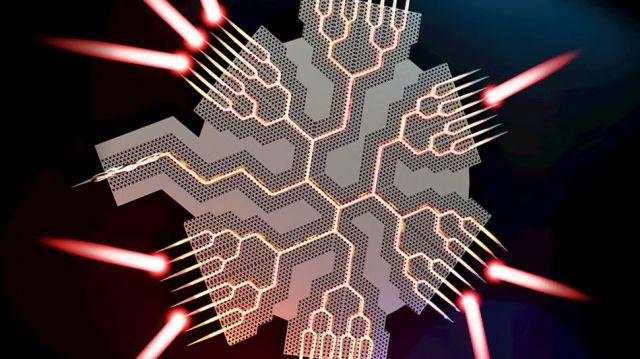
Meanwhile, the University of Notre Dame has developed a silicon topological beamformer chip, which was recently featured in Nature. “Our chip takes a terahertz signal from a single source and splits it into 54 smaller signals,” lead researcher Ranjan Singh wrote in an article for The Conversation.
“Terahertz frequencies are crucial for 6G, which telecommunications companies plan to roll out around 2030. The radio frequency spectrum used by current wireless networks is becoming increasingly congested. Terahertz waves offer a solution by using the relatively unoccupied portion of the electromagnetic spectrum between microwaves and infrared. These higher frequencies can carry massive amounts of data, making them ideal for the data-intensive applications of the future.”
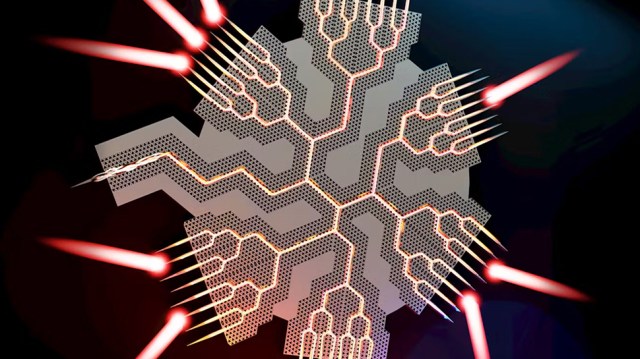
Designed with artificial intelligence, the chip features a honeycomb structure that channels terahertz waves with precision, delivering focused beams for ultrafast data transmission at speeds of up to 72 gigabits per second. You can see an illustration of this experimental chip at the top of the page.
These terahertz technologies have wide-ranging applications, from enabling instant downloads of 4K ultra-high-definition movies to supporting real-time holographic communication and remote surgeries. The potential for these breakthroughs could revolutionize telecommunications, imaging, radar, and the internet of things in the coming decade.
More from TechRadar Pro
Universities worldwide are competing to lead the development of 6G technology, focusing on advances in terahertz communications and innovative silicon chips which promise data transmission rates far beyond current capabilities, potentially transforming how we communicate in the future. A team from the University of Adelaide has made significant strides, introducing…
