Fi Ultra is the first Starlink-enabled pet tracker you can buy. It expands on GPS and LTE trackers, adding automatic failover to T-Mobile’s T-Satellite-branded direct-to-cell service when venturing into cellular dead zones. That lets owners tap into SpaceX’s constellation of low Earth orbit Starlink satellites to track their pets anywhere in the US. But it comes with a few tradeoffs based on our early testing, including relatively poor battery life for a pet tracker.
Fi’s Starlink-enabled pet tracker found my dog when LTE couldn’t

Built to fit “adventure dogs of any size,” according to the company, the Fi Ultra is designed to be compatible with the dog collar or harness you already use. It costs $199 for the device (plus a $20 activation fee) and requires an $189 annual subscription. Along with LTE cellular connectivity, it features always-on, dual-band GPS, Bluetooth, and Wi-Fi for added precision.
$199
The Fi Ultra is the first dog tracker to combine T-Satellite with Starlink, GPS, and LTE connectivity to help you find your lost dog anywhere. There’s a $189 annual fee, and it only lasts two days on a single charge, but if you go on wild adventures with your pup, it might be worth it.
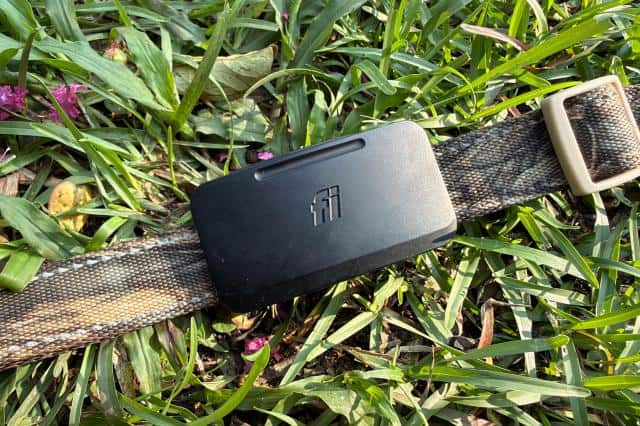
There’s a 513 mAh battery slated to last two days in this wide 75mm × 40mm × 25mm tracker, which weighs 68g. Its IP68 and IP66K ratings protect against dust and water ingress, including saltwater. It also packs in a small vibration motor and speaker in support of Fi’s new shock-free Callback training system.
To test the Fi Ultra, I drove about an hour away to near the Francis Marion National Forest in South Carolina, where the LTE drops off, and the alligators climb out of the rivers. It was easy to attach the tracker to my dog Gus’ collar, thanks to a spring-mounted clasp. But “dogs of any size” feels like a stretch. It looked big on Gus, an 80-pound wirehaired pointing griffon, and it’s easily wider than a Chihuahua’s neck, although toy breeds aren’t known for adventurous hikes.

The Fi Ultra connects to the Fi app, which shows a live view of Gus’ location. I simulated a lost-dog emergency by hitting Lost Mode, which ramps up all the radios to attempt to track him in real time (instead of checking in periodically).
Outside of regular LTE, the tracker quickly connected to the Starlink-based T-Satellite network (indicated by a satellite icon in the app), and the map updated about every 2 to 3 minutes, showing where he was relative to me. While relatively slow, this is about the same update interval as when I tested it on 1 bar of LTE in my neighborhood.
Three minutes is a long time, and by the next update, Gus could be anywhere (if he’d actually been on the lamb). But it’s better than nothing, which is the alternative in LTE-dead zones.
1/5
During my 30-minute live tracking session connected to Starlink satellites, there were a couple of times it got stuck “reconnecting” and didn’t update location for almost 5 minutes.
According to Fi, the tracker prioritizes terrestrial cell towers. But when using T-Satellite, it has to change satellites often while still trying to acquire a terrestrial signal — because even one bar of LTE generally wins over satellite for connection stability. Fi says this sometimes results in reconnection lags as the tracker moves in and out of coverage.
All those radios are tough on a tracker’s battery, and I barely got the promised two days on a charge during my week of testing. I had to charge it daily if I went for a long walk, or every other day when we were less active. During the 30-minute live tracking session alone, it dropped almost 20 percent.


While it charged in under 2 hours via USB-C, the short battery life makes this more of an expensive tracker for occasional use than an everyday one. Fi’s other trackers, the Fi Mini and Fi 3 Plus collar, can last several weeks on a single charge and offer more features, including health, sleep, and behavior tracking. They are also included with a paid membership.
The company said the battery life is due to the “added power cost of supporting satellite connectivity on top of cellular, plus more frequent high-accuracy location updates.” The device relies more on GPS for always-on tracking, unlike Fi’s non-Satellite-enabled trackers.
However, the Fi Ultra can be added to an existing subscription for a flat fee of $299, which is a better deal long-term than buying it standalone. You can clip it onto an existing Fi collar, and the two devices will work together in the app, giving you confidence that you’re covered when hiking in areas with no cell service, while also getting the benefits of Fi’s standard dog tracker.
I used to live in rural Idaho, where my dog Stanley regularly disappeared down valleys chasing deer, so I understand the appeal of a tracker that works beyond cellular coverage. If you regularly hike or camp in remote areas, Fi Ultra could be worthwhile as an expensive form of insurance. The T-Satellite fallback works and offers real peace of mind. Just be prepared to charge it far more often than a conventional GPS tracker.
Photos by Jennifer Pattison Tuohy / The Verge
Follow topics and authors from this story to see more like this in your personalized homepage feed and to receive email updates.
Fi Ultra is the first Starlink-enabled pet tracker you can buy. It expands on GPS and LTE trackers, adding automatic failover to T-Mobile’s T-Satellite-branded direct-to-cell service when venturing into cellular dead zones. That lets owners tap into SpaceX’s constellation of low Earth orbit Starlink satellites to track their pets anywhere…
