EV range anxiety could be a thing of the past thanks to Mercedes’ new solar paint – which promises thousands of free miles a year

- Mercedes has unveiled a series of future innovations during workshops
- Its ‘solar paint’ contains no rare earths and no toxic materials
- Aerodynamic braking and power converters aim to improve EV efficiencies
What is solar paint?
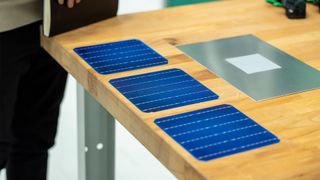
Mercedes says it’s new kind of solar paint can be used on “all exterior vehicle surfaces”. It also claims it’s “considerably cheaper” to produce to typical solar modules and is easy to recycle, thanks to the lack of rare earth materials and silicon.
The utopian dream of solar-powered motoring might not be so distant, as Mercedes-Benz recently opened the doors to some of its most forward-thinking engineering laboratories – and it turns out photovoltaic surfaces are very much on the agenda.
During a number of workshops in its home city of Stuttgart, Germany, Mercedes-Benz lifted the lid on how it has been working on a new kind of solar surface that could generate enough electricity for folks in sunnier climates to cover their daily commuting requirements.
According to the German marque, the ‘solar modules’ measure just five micrometers in thickness – significantly thinner than a human hair – and weigh just 50 grams per square meter. They can be applied to almost any substrate, with applications of future vehicles likely coming in the form of a “wafer-thin layer of paste” that will cover most of the body work.
Mercedes-Benz has past experience with solar panels and the impact they can have on the electric range of EVs, as the company’s record-breaking EQXX concept (the rolling lab that drove more than 620 miles on a single charge) used a small solar panel on the roof that added around 30km (18 miles) of additional range during one of its long distance record attempts.
But the breakthrough in photovoltaic surface treatments means much more of a vehicle could be covered, equating to a much greater increase in additional EV mileage.
No giant solar panels needed

Taking a fairly standard mid-sized SUV like the marque’s EQS as an example, Mercedes engineers claim the 11 square meter surface area and the 20% solar efficiencies of the technology would be enough to generate around 7,400-miles of motoring per year in somewhere sunny, like Los Angeles.
Nanoparticle-based paint would also allow 94% of the sun’s energy to pass through to the solar coating, meaning future EVs won’t necessarily have to look like giant solar panels.
Studying the daily driving habits of EV owners in Stuttgart, Germany, those close to the project found they cover an average of 52 kilometers (around 32 miles) a day. Around 62% of this distance would be covered using solar energy, the company says, despite the often poor weather conditions.
Again, if you live somewhere with plenty of excess sunshine, the ‘always-on’ nature of a photovoltaic surface means the vehicle could effectively be charging, even when parked.
As a result, LA owners could cover 100% of their driving distance on average by solar energy. Any surplus achieved could be fed directly into the home network via bidirectional charging, in theory.
Braking down inefficiencies

Alongside pondering the state of future cities and speeding up AI decisions with neuromorphic computing, Mercedes-Benz also touched on the fact that it is also working on an EV braking system that removes the need for standard discs, drums and pads.
Effectively ridding the world of harmful particles emitted in the form of brake dust, Mercedes’ innovation is integrated into the electric drive unit at the front or rear axle, negating the need for in-wheel brakes.
Not only would this be subject to minimal wear and take up less space, it would also mean the company could look at much lighter wheel and tyre combinations, reducing the overall mass of an EV, as well as exploring fully-enclosed rims for optimized aerodynamics, as openings for brake cooling would no longer be required.
Plus, the company’s research into electrical inverter systems could see the integration of micro-converters directly at battery-cell level, which would allow for greater control over individual cells.
It is complicated stuff, but it would result in more efficient battery performance, increased the longevity of battery pack lifespans and greater freedom when it comes to packaging – allowing engineers to use varying cell designs throughout the vehicle.
All of these advancements are still a long way from making production, but it is good to see Mercedes-Benz busy exploring innovations that offer its future customers real-world value.
You might also like

Mercedes has unveiled a series of future innovations during workshops Its ‘solar paint’ contains no rare earths and no toxic materials Aerodynamic braking and power converters aim to improve EV efficiencies What is solar paint? (Image credit: Mercedes-Benz) Mercedes says it’s new kind of solar paint can be used on…
