DJI’s first power stations can fast charge its drone batteries
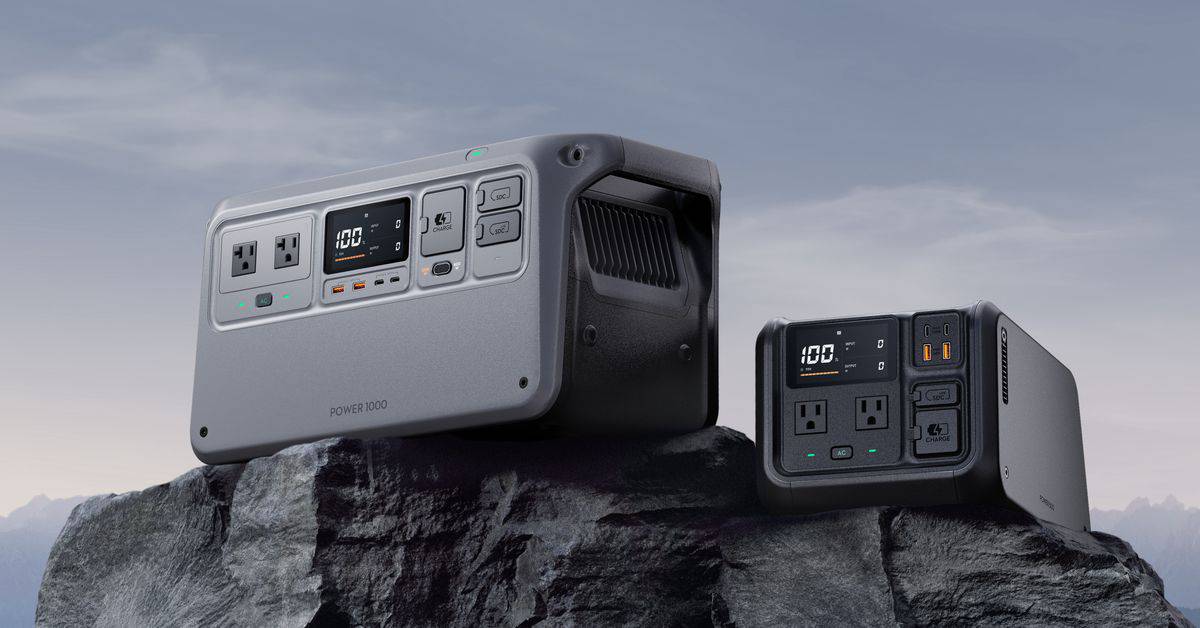
DJI just launched its first power stations that feature a new proprietary SDC — aka Smart DC — port that can fast charge (some) DJI drone batteries and supports lots of input and output accessories. The $699 Power 1000 and smaller $379 Power 500 both offer a bevy of AC and DC inputs and outputs with more available if you’re willing to fully commit to living DJI’s SDC dongle life.
The Power 500 has one SDC Lite port, while the larger Power 1000 has both regular SDC and SDC Lite. Both power stations are fitted with batteries that use LFP chemistry, which is safer and lasts longer (80 percent capacity after 3000 cycles) than traditional NMC, and both offer a 0.02-second cutover making them suitable for use as a UPS on unstable grids. They arrive without an app, though, which is a common and useful way to manage power stations remotely.
The 1024Wh Power 1000 is the flagship offering. Besides the SDC and SDC Lite ports, its other notable feature is two USB-C ports that each support a max output (no input) of 140W so long as you’re using the right cable to connect a PD 3.1 USB-C device like a laptop. Its AC outputs can produce up to 2200W AC (2400W in Europe) which is enough to power any device you might take on a shoot or camping trip.
The power station itself can be fully charged in as little as 70 minutes at its max input of 1200W, or it can be dumbed down to 600W with a switch on the front that also reduces the fan noise to 23dB (which is very quiet for a power station). It weighs 13kg, or almost 29 pounds.
DJI tells me that there’s no real difference between how the bi-directional SDC and SDC Lite ports function right now. The current spec sheet lists the ports as follows:
DJI’s SDC ports support the company’s “Power SDC super-fast charge function,” which pulls as much as 230W for Metric 30 Series TB30 Intelligent Flight batteries, 200W for Inspire 3 TB51 Intelligent batteries, 150W for Mavic 3 Intelligent Flight batteries, and 125W for DJI Air 3 Intelligent Flight batteries, but only after you buy the $19 cable specific to each drone series.
Each SDC port can also be used to recharge the power station with up to 400W of solar panels, but only after you buy the $59 DJI Power Solar Panel Adapter Module (MPPT). That’s a unique approach, since those DC-to-DC converters are something you’d find standard inside a class of power stations commonly called solar generators. You can even plug two MPPTs into the Power 1000 for 800W of total input. DJI also lets you bolt these onto the side of the unit to go full Frankenstein.
DJI doesn’t make its own solar panels but it is reselling Zignes panels to help ensure you don’t screw things up by “overvolting” your setup.
And this is just the start. DJI tells me that in the future, the SDC ports might support higher power and capacity accessories through firmware upgrades.
The smaller 512Wh Power 500 dials things back with a pair of 100W USB-C ports that can also be used to charge the unit, unlike the Power 1000. It can be charged at 540W or 270W, and its AC max output is limited to 1000W. The Power 500 weighs just 7.3kg, or about 16 pounds.
I’m super curious to see how people respond to DJI’s adapter heavy and proprietary approach to power stations. I can see several pros if you own a compatible DJI drone, but lots of cons if you don’t.
DJI just launched its first power stations that feature a new proprietary SDC — aka Smart DC — port that can fast charge (some) DJI drone batteries and supports lots of input and output accessories. The $699 Power 1000 and smaller $379 Power 500 both offer a bevy of AC and…
