Daimler Truck, a subsidiary of the Mercedes-Benz parent company, revealed its first autonomous truck demonstrator that it said will pave the way to fully driverless freight hauling by 2027.
Daimler’s driverless semi trucks will hit the road in 2027

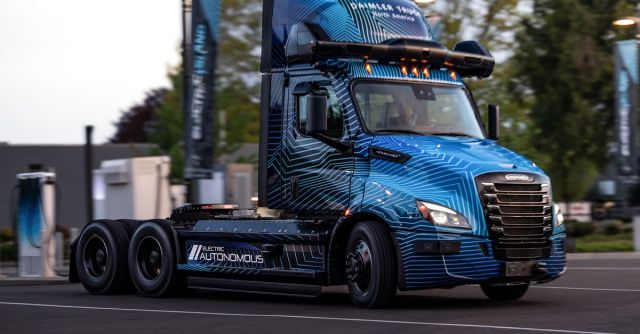
The demonstrator is an all-electric version of Daimler’s popular Freightliner Cascadia models. The so-called eCascadia has been fitted with a suite of high-powered, long-range sensors that enable it to “see” its surrounding environment as well as a high-powered computer that can process the sensor data and make navigation decisions.
Daimler, which is working with Waymo and its own Torc subsidiary on autonomous systems, says the goal is to launch the trucks somewhere in the Southwest US, transporting goods from hub to hub as part of a middle-mile freight hauling service in 2027.
We’re starting with “an autonomous vehicle that doesn’t sleep, doesn’t need to stop, and basically can drive continuously in the Level 4 hub-to-hub mode — that is our targeted use case,” said Joanna Butler, head of Daimler’s global autonomous technology group, in a briefing with reporters.
Daimler Truck is “fully committed” to bringing the autonomous Freightliner to series production, but only when the company deems the technology safe enough to begin testing on public roads. Butler added, “Our mantra is really it’s a marathon, and not a sprint.”
Autonomous trucks were once thought to beat robotaxis and personally owned autonomous vehicles to market but have run into familiar obstacles on the bumpy road to mass adoption. Some driverless trucking companies have gone out of business, while others have cut plans to deploy driverless trucks as timelines have stretched into the future and funding has dried up.
Moreover, public opinion toward autonomous vehicles has trended downward thanks in part to missteps of companies like Tesla and Cruise, the latter of which was forced to pause operations nationwide after a pedestrian was hurt by one of its vehicles. Meanwhile, Tesla CEO Elon Musk has bet his company’s future on its ability to mass-produce fully autonomous robotaxis.
Daimler has been working on its own self-driving big rig since 2015, when it showed off a working prototype called the Freightliner Inspiration Truck. The automaker went big, debuting the truck on the Hoover Dam and offering test rides at Las Vegas Motor Speedway. At the 2019 Consumer Electronics Show, Daimler showed off a production version of that prototype truck.
Also that year, Daimler Truck acquired Torc, a Virginia-based company that makes software to power self-driving vehicles. The following year, it partnered with Google spinoff Waymo, with the goal to produce fully autonomous semi trucks.
The demonstrator that Daimler revealed today runs on Torc’s computer system, though the company says it will also produce trucks that use Waymo’s technology. For its laser-producing lidar sensors, Daimler chose Mountain View, California-based Aeva Technologies as its supplier. In addition, there are three short-range radar, six long-range radar, and an additional four ultra-long-range radars.
The demonstrator’s sensor bar, which is situated over the top of the vehicle’s windshield, “gives us a very rich perception of the environment so that the virtual driver can make the necessary decisions,” said Suman Narayanan, Daimler’s director of autonomous driving engineering.
Safety drivers will remain in the vehicle during testing and will be responsible for more complex scenarios, like last-mile delivery or emergency operations, Butler said. But the company’s engineering team can already envision more futuristic designs that eschew traditional controls like steering wheels.
“That is, of course, a huge bold vision,” Butler said.
Daimler’s demonstrator vehicle is all-electric, but the company is building its self-driving system to be “agnostic” when it comes to powertrain, Butler said. In that way, the company can provide a range of models to its customers based on their specific needs, including hydrogen fuel cell propulsion systems.
But the company is most interested in how an electric semi truck interacts with an autonomous driving system and vice versa. Driverless systems have been known to be extremely power-hungry, which could affect the range and towing. But Daimler says it’s confident it can land on the right balance.
“This is our chance to learn and bring two emerging technologies, autonomous and electric, together so that we can learn certain elements of how to get it ready for our future challenges,” Narayanan said.
Daimler Truck, a subsidiary of the Mercedes-Benz parent company, revealed its first autonomous truck demonstrator that it said will pave the way to fully driverless freight hauling by 2027. The demonstrator is an all-electric version of Daimler’s popular Freightliner Cascadia models. The so-called eCascadia has been fitted with a suite…
