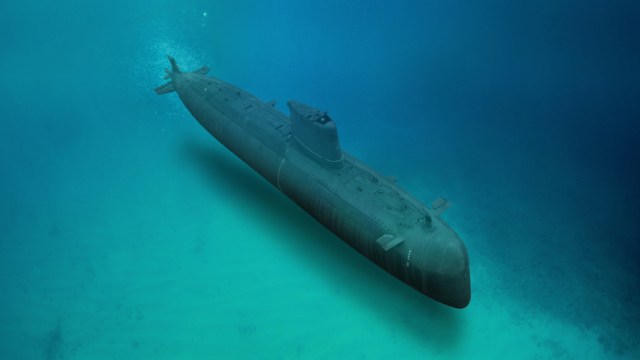
Could AI soon make dozens of billion-dollar nuclear stealth attack submarines more expensive and obsolete?


- AI can process far more data from a far more sensors than human operators can ever achieve
- But the game of cat-and-mouse means that countermeasures do exist to confuse AI
- Increase in compute performance and ubiquity of always-on passive sensors need also be accounted for
The rise of AI is set to reduce the effectiveness of nuclear stealth attack submarines.
These advanced billion-dollar subs, designed to operate undetected in hostile waters, have long been at the forefront of naval defense. However, AI-driven advancements in sensor technology and data analysis are threatening their covert capabilities, potentially rendering them less effective.
An article by Foreign Policy and IEEE Spectrum now claims AI systems can process vast amounts of data from distributed sensor networks, far surpassing the capabilities of human operators. Quantum sensors, underwater surveillance arrays, and satellite-based imaging now collect detailed environmental data, while AI algorithms can identify even subtle anomalies, such as disturbances caused by submarines. Unlike human analysts, who might overlook minor patterns, AI excels at spotting these tiny shifts, increasing the effectiveness of detection systems.
Game of cat-and-mouse
AI’s increasing role could challenge the stealth of submarines like those in the Virginia-class, which rely on sophisticated engineering to minimize their detectable signatures.
Noise-dampening tiles, vibration-reducing materials, and pump-jet propulsors are designed to evade detection, but AI-enabled networks are increasingly adept at overcoming these methods. The ubiquity of passive sensors and continuous improvements in computational performance are increasing the reach and resolution of these detection systems, creating an environment of heightened transparency in the oceans.
Despite these advances, the game of cat-and-mouse persists, as countermeasures are, inevitably, being developed to outwit AI detection.
These tactics, as explored in the Foreign Policy and IEEE Spectrum piece, include noise-camouflaging techniques that mimic natural marine sounds, deploying uncrewed underwater vehicles (UUVs) to create diversions, and even cyberattacks aimed at corrupting the integrity of AI algorithms. Such methods seek to confuse and overwhelm AI systems, maintaining an edge in undersea warfare.
As AI technology evolves, nations will need to weigh up the escalating costs of nuclear stealth submarines against the potential for their obsolescence. Countermeasures may provide temporary degree of relief, but the increasing prevalence of passive sensors and AI-driven analysis suggests that traditional submarine stealth is likely to face diminishing returns in the long term.
You might also like
AI can process far more data from a far more sensors than human operators can ever achieve But the game of cat-and-mouse means that countermeasures do exist to confuse AI Increase in compute performance and ubiquity of always-on passive sensors need also be accounted for The rise of AI is…
