China launches new compact radiation detection chip for semiconductor self-reliance

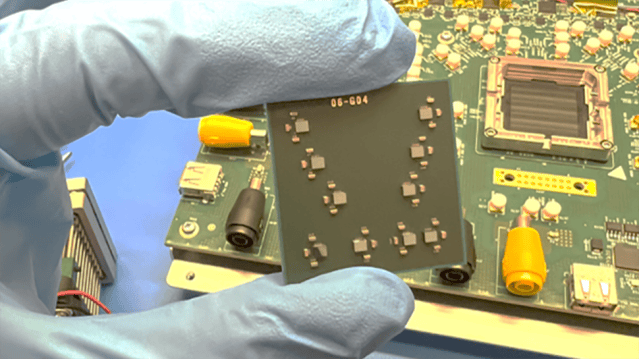
- Chinese firm develops new compact radiation detection chip
- The chip measures just 15mm x 15mm x 3mm and consumes 1 milliwatt in operation
- The chip could be planted in phones and drones for every
Amid escalating efforts to boost its national semiconductor self-reliance, China National Nuclear Corporation (CNNC), a state-owned nuclear enterprise, has revealed the development of a groundbreaking radiation detection chip.
According to CNNC’s official statement on its WeChat channel, the chip can monitor radiation doses across a wide range of environments and adapt to multiple settings including nuclear workplaces, personnel monitoring, and environmental safety inspections.
This chip measures dose rates from 100 nanoSievert (nSv) per hour to 10 milliSievert (mSv) per hour, allowing it to cover various use cases, from monitoring natural background radiation (typically 60–200 nSv/h) to more specific industrial scenarios.
Versatile applications and high-sensitivity
The chip can also detect radiation energies between 50 kiloelectron volts (keV) and 2 mega-electron volts (MeV). This range covers both X-rays and gamma rays, making it useful for industries such as healthcare, nuclear energy, and environmental monitoring.
The chip measures only 15mm x 15mm x 3mm and its energy consumption to operate is just 1 milliwatt. Despite its miniature form, the chip offers sensitivity comparable to traditional Geiger-Muller counters, which are widely used for environmental radiation measurement.
The company announced mass production of the chip has now begun, marking a significant milestone in China’s technological push in radiation sensing applications.
This achievement is seen as part of the broader strategy to overcome trade and technology restrictions imposed by the United States, particularly in the semiconductor sector.
Speaking to Chinese state news agency, Xinhua, during his visit to the southeastern high-tech hub of Hefei, Chinese President Xi Jinping said, “High-tech development cannot be begged for; we must accelerate the realisation of high-level technological self-reliance and self-improvement.”
CNNC envisions broader applications beyond industrial use, stating that the chip can be integrated into consumer devices such as smartphones and drones. This could enable smart devices to offer real-time radiation detection, opening up new possibilities for consumer and environmental safety applications.
The development of this chip involved the full cycle of semiconductor production, including chip design, tape-out, packaging, and testing. The mass production was outsourced to “authorized factories,” though details about these partners were not disclosed.
Via SCMP
You might also like
Chinese firm develops new compact radiation detection chip The chip measures just 15mm x 15mm x 3mm and consumes 1 milliwatt in operation The chip could be planted in phones and drones for every Amid escalating efforts to boost its national semiconductor self-reliance, China National Nuclear Corporation (CNNC), a state-owned…
