Canon’s budget-friendly 3D lens will be available in November

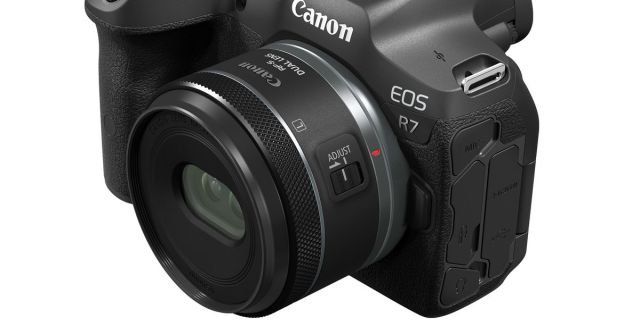
Canon has officially announced its new RF-S7.8mm F4 STM Dual lens, which features stereoscopic elements that have been squeezed into a body no larger than a traditional 2D camera lens. It was originally teased during the Apple WWDC 2024 keynote last June and is designed to work with a Canon EOS R7 as a more affordable tool for creators making 3D VR content for headsets like the Meta Quest 3 or spatial videos for the Apple Vision Pro.
The company hasn’t set a specific date for when the new 3D lens will be available, but it says it will be sometime in November 2024, with an “estimated retail price” of $449.99. That’s considerably cheaper than Canon’s existing dual-fisheye lenses designed to capture 3D video content, including the $1,999 RF5.2mm F2.8 L Dual and the $1,099 RF-S3.9mm F3.5 STM Dual.
Pairing Canon’s new 3D lens with the company’s 32.5MP EOS R7 digital camera — which itself starts at $1,299 — pushes the total price tag of the kit to over $1,700. However, that’s still cheaper than Canon’s higher-end 3D solutions, which start at $2,498 (and can go as high as $6,298) when paired with their requisite camera gear.
Canon’s new 3D lens has an aperture range of f/4.0 to f/16, supports autofocus, and features a button and a control wheel for making separate manual focus adjustments to the left and right sides. What makes it so much cheaper than Canon’s existing 3D lenses is its limited field of view. Canon’s pricier lenses are capable of capturing 180-degree video and images — close to what the human eye is capable of seeing — while the new RF-S7.8mm F4 STM Dual lens only takes in about a third of that at 63 degrees.
Using a standard Canon RF mount, the new lens has stereoscopic elements aligned in a straight optical path, resulting in its front lenses being positioned just 11.8mm apart compared to the 60mm gap between the dual-fisheye lenses on Canon’s existing 3D lenses. As a result, Canon says the strongest 3D effect will be experienced when capturing subjects or objects that are just 6 to 20 inches from the lens. When using it to capture something that’s farther away, the 3D effect will be less pronounced.
Images and videos captured using this lens need to be processed before they can be viewed using VR or AR headsets, either through the EOS VR plugin that’s available for Adobe Premiere Pro, or Canon’s own EOS VR Utility software, available for Macs and PCs. Both tools require a paid subscription but can generate 180-degree 3D, VR, or spatial video content.
Canon has officially announced its new RF-S7.8mm F4 STM Dual lens, which features stereoscopic elements that have been squeezed into a body no larger than a traditional 2D camera lens. It was originally teased during the Apple WWDC 2024 keynote last June and is designed to work with a Canon…
