Bringing Fallout’s gritty retrofuturism into the real world

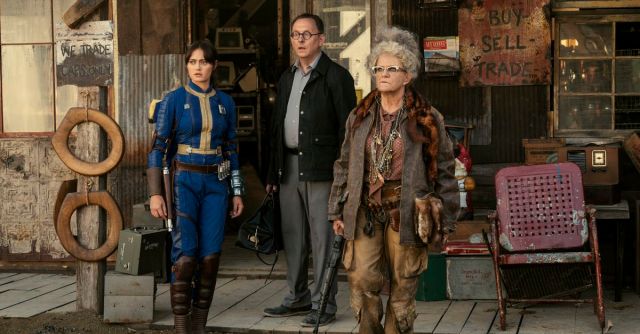
For production designer Howard Cummings, Fallout wasn’t just the name of his most recent project — it also became a verb. As he was working on Amazon’s live-action adaptation of the game series, Cummings and his team used the word Fallout as a shorthand to describe the particular retrofuturistic, post-apocalyptic style the franchise is known for. “Everything had to be Fallout-ed,” he tells The Verge. “For locations, I’d say: ‘How do I Fallout this grocery store?’”
Initially, though, that wasn’t the plan. Going into the project, Cummings — who previously worked on shows like Westworld and Lovecraft Country — didn’t know all that much about the games and thought he might have to update the visual style to make it “slicker.” That changed once he did some research. After watching YouTube videos of fans building their own vaults and Pip-Boys and scouring wikis for every detail he could find, Cummings says he became enchanted by the franchise’s mix of playful and dark. “The script was actually so well-written to the game that we decided that we should absolutely do it like the game,” he explains. “Nobody ever told me to do that, which was kind of great. I did it because I really liked it.”
Cummings says that he got “into a groove after a while, with what makes something Fallout.” And that meant being really focused on the details. The underground vaults, for example, had completely unique features like triangular bolts and lots of metal arches, all of which had to be custom-made for the show. “We had our own factory for computer cuts and Vacuform,” Cummings says. “I had a row of 3D printers in my office for all of the small parts.” When it came to the settlement of Filly, “Fallout-ing” meant crafting a small town mostly out of metal, with structures that could be 60 feet tall in some places (not including the airplane fuselage resting on top). Cummings says that it required more than 30 welders working on set each day to put it together.
One element of Fallout lore that Cummings particularly loved was the Red Rocket truck stops, with their distinctive sloping roofs and giant red rockets. But initially, there wasn’t one in the script. “I begged Graham [Wagner] and Geneva [Robertson-Dworet], the showrunners, to let me do a Red Rocket,” Cummings says. Eventually, they found a functioning 1950s gas station in Nyack, New York, that had the right look, and the owner gave the team five days to use the space. That meant three days to prep, one day of shooting, and then one day to “return it back to a functioning gas station.”
Not everything got the Fallout treatment, however. In the games, shots of the pre-war world usually consist of a series of perfectly pleasant suburban homes ripped out of a 1950s sitcom. But for a scene early on in the Amazon show featuring a children’s birthday party at a rich executive’s home, the vibe needed to be different. Instead of “Fallout-ing” a location, Cummings and the design team instead crafted a sleek, mostly glass house inspired by the futurist Googie architectural movement. It was a different look that still fit within Fallout’s time period and aesthetic — and also made one of the more tragic parts of the show even more dramatic. “If you’re going to have an atomic bomb go off,” says Cummings, “you do not want to live in a glass house.”
For production designer Howard Cummings, Fallout wasn’t just the name of his most recent project — it also became a verb. As he was working on Amazon’s live-action adaptation of the game series, Cummings and his team used the word Fallout as a shorthand to describe the particular retrofuturistic, post-apocalyptic…
