Battery-powered robot crabs, 4TB glass discs and Hololens tech: A deep dive into Project Silica reveals how Microsoft doesn’t want petabyte capacity quartz disks just yet

The cover feature of the June 2024 of DataCenterDynamics (DCD) takes a fascinating and detailed look into the world of Project Silica, a research initiative by Microsoft aimed at developing a new storage technology using quartz glass as a medium for long-term data storage.
Microsoft’s vision for Project Silica comes at a time when the world is producing more data that traditional data storage solutions can effectively manage, a problem exacerbated by generative AI. Project Silica’s solution to this problem is to use femtosecond lasers to etch data into glass discs, creating deformations that are readable with a microscope. This method promises a storage lifespan that could exceed 10,000 years.
Richard Black, a key figure in the Project Silica team, told DataCenterDynamics that it was clear the short lifespan and high maintenance costs of current storage media was a problem. “We just realized that, in the archival space, we needed a better medium,” he said. The answer, it turned out, was glass.
“We pushed the density a lot”
Microsoft harnessed the femtosecond laser technology developed at Southampton University and enhanced it. Although the team was able to hit 4TB and 7TB densities, the project’s focus has since shifted to accommodate the specific needs of Microsoft’s Azure cloud service. “We pushed the density a lot, eventually the Azure business asked us to stop,” he told DCD.
Project Silica is now incorporating advanced AI and deep learning technologies to enhance data retrieval accuracy and efficiency. This not only reduces the necessity for error correction but also boosts overall storage density. The data encoded on these durable glass discs is virtually immutable, offering protection against tampering and ransomware threats.
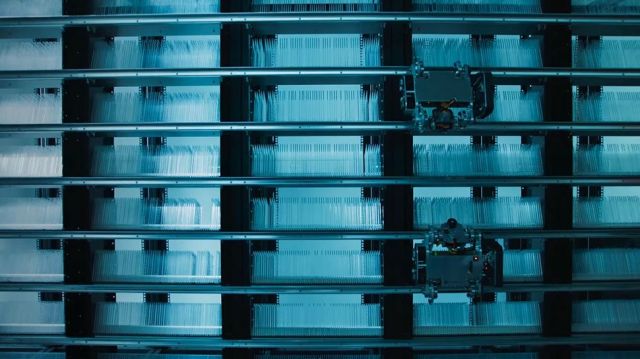
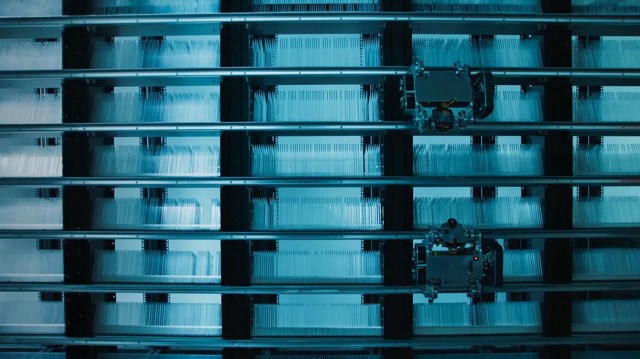
An unusual aspect of Project Silica is its use of battery-powered robotic “crabs”. These robots (visible in the photo above) efficiently navigate storage aisles to retrieve and deliver glass platters to reading stations. I’ve actually seen these in action, and they are fast!
Although the data-writing stations currently require substantial space, Black anticipates smaller production versions in the future. “When I first saw Hololens, it was much larger than this,” he told Sebastian Moss, DCD’s Editor-in-Chief, suggesting potential scalability and the involvement of Microsoft’s optics-savvy HoloLens team in refining the future technology.
Despite the project’s ambitious scope, Black and his team maintain a level of secrecy regarding the final specifications. However, the potential of Project Silica to redefine archival storage is clear.
More from TechRadar Pro
The cover feature of the June 2024 of DataCenterDynamics (DCD) takes a fascinating and detailed look into the world of Project Silica, a research initiative by Microsoft aimed at developing a new storage technology using quartz glass as a medium for long-term data storage. Microsoft’s vision for Project Silica comes…
