Anker’s second 3D printer is the more affordable AnkerMake M5C

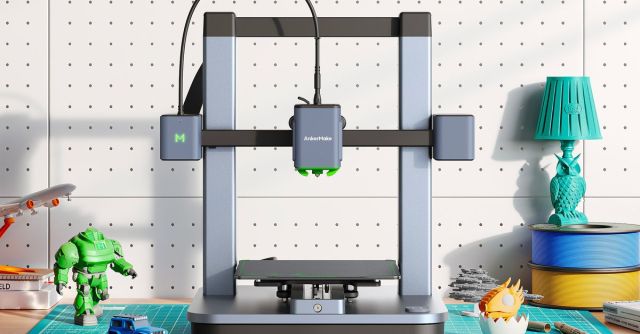
Anker didn’t exactly knock it out of the park with its first 3D printer, the AnkerMake M5, but today, it’s trying again. The new AnkerMake M5C, shipping today in the United States, ditches some of the original’s clumsier features in exchange for a $400 price tag. That’s half what the AnkerMake M5 cost when it arrived last year.
The M5C still offers the same 49-point automatic bed leveling system, removable flexible magnetic plate for easy adhesion and removal, and remarkably fast printing speeds up to 500mm per second (though no promises about quality at maximum speed). It still prints down to 0.1mm in resolution, has a hefty aluminum base and dual screws for the Z-axis, and now boasts a one-piece design for faster, simpler setup. Print volume is just slightly smaller at 220 x 220 x 250mm instead of 235 x 235 x 250.
Importantly, it now comes with an all-metal hotend, something the M5 lacked. (While Kickstarter backers were promised one for meeting stretch goals, Anker later claimed it was a misunderstanding.) All-metal hotends let the machine reach higher temperatures to melt tougher filaments and — done right — can help prevent certain kinds of jams.
So, what do you give up in exchange for the $400 price tag? Here are M5 features that the M5C lacks:
That last is a weird omission! Printers half the price of the AnkerMake M5C still come with a screen, and they’re quite handy to monitor the status of your print and make calibration tweaks. Here, you’ll have to use Anker’s still-in-beta PC and Mac slicing software and Android and iOS apps instead.
“The intuitive AnkerMake app empowers users to monitor the status of prints, control the printer, and transfer sliced models directly from their smartphone or laptop,” reads a line from the company’s press release.
You do get one control on the printer itself, though: a single programmable button you can press, double-tap, or long-press to activate three functions of your choice. I’d rather have a screen, but I suppose I’d program mine to pause, play, and raise the gantry 100mm to more easily get at the bed — something I did often with the original AnkerMake M5 by repeatedly stabbing a touchscreen.
The AnkerMake M5C still doesn’t have an SD card slot but does retain a port for a USB thumbdrive on the right side of the base — it’ll be nice to no longer have it atop the moving gantry.
I didn’t enjoy beta testing Anker’s first 3D printer, but I have to admit that it got a bit better, and it sounds like this new one may have fewer points of failure. But the real question is whether the company’s quality control has improved, something that (I keep hearing) also afflicts some buyers of lower-priced Creality machines.
Personally, I’ve moved on to a $700 Bambu P1P (currently on sale for $600 now that Bambu has introduced the enclosed P1S), and I’ve never had an easier time printing than now. And I’m looking forward to seeing if the $600 Creality K1, a very similar machine, is its equal or better.
Anker didn’t exactly knock it out of the park with its first 3D printer, the AnkerMake M5, but today, it’s trying again. The new AnkerMake M5C, shipping today in the United States, ditches some of the original’s clumsier features in exchange for a $400 price tag. That’s half what the…
