An obscure 4-year-old Intel SSD is still the world’s fastest despite WD Black SN8100’s outstanding performance in benchmarks

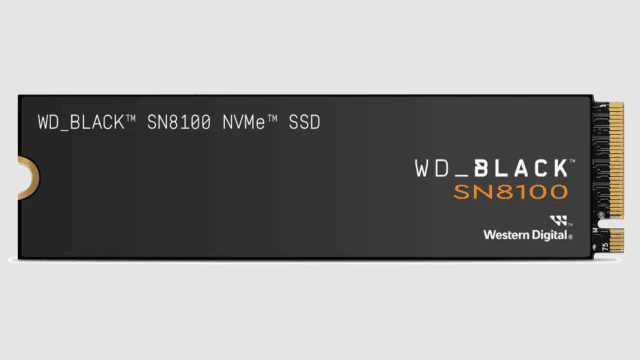
- SN8100 tops flash-based SSD charts with record speeds and great thermals with no fan required
- Sandisk’s SN8100 delivers stunning PCIe Gen5 performance with nearly 15 GB/s read speeds
- Intel’s four-year-old Optane P5800X still outpaces the SN8100 in real-world speed tests
SanDisk’s new WD Black SN8100 PCIe Gen5 SSD is fast, efficient, and engineered to meet the demands of gamers and power users alike.
The drive uses a PCIe Gen5 x4 interface and is available in 1TB, 2TB, and 4TB capacities. Built around SanDisk’s in-house 8-channel controller and BiCS 3D TLC NAND, it supports read speeds of up to 14.5 GB/s and write speeds up to 12.7 GB/s, placing it among the fastest Gen5 drives currently available.
However, despite the SN8100’s cutting-edge design and impressive benchmarks, Intel’s now-defunct, four-year-old Optane P5800X still holds the crown as the fastest SSD in real-world use.
Benchmarks suggest top speeds – but not across the board
In synthetic benchmarks like CrystalDiskMark and ATTO, the SN8100 breaks lab records for sequential throughput and random reads, reaching up to 2.3 million IOPS.
According to TweakTown, “this SSD is like none other; it’s at least 20% more powerful than any flash-based SSD we’ve ever encountered.”
It also demonstrates notable efficiency, consuming just 7 watts under load and requiring no active cooling, making it a serious contender for best SSD or the best portable SSD for enthusiast builds.
Still, synthetic benchmarks don’t always reflect real-world performance. In practical transfer tests, the SN8100 ranked ninth overall, indicating that while it’s extremely fast, it’s not without limitations, and it doesn’t dethrone the Intel Optane P5800X.
Launched in 2021, the P5800X remains unmatched in real-world responsiveness and latency. While its sequential read speeds top out at 7.2 GB/s – slower than the SN8100 – its random read/write IOPS exceed 4.5 million, and latency frequently drops below 10 microseconds. That’s where it truly shines.
Flash-based SSDs like the SN8100 still rely on garbage collection and page-level management, leading to occasional latency spikes during small, random workloads. In contrast, the P5800X maintains consistent performance under heavy load, with no significant dips, a key reason why it’s still regarded as the fastest SSD ever made.
That said, the SN8100 is an impressive drive in its own right. It’s a customized version of Silicon Motion’s SM2508 controller, enhanced with proprietary technologies like nCache 4.0 and WD Black Gaming Mode.
It also fits into the Sony PlayStation 5’s expansion slot, achieving read speeds of 6,550 MB/s in that setup, well above the console’s minimum requirement. However, with a price tag of $280 for the 2TB model, it clearly belongs in the premium tier.
You might also like
SN8100 tops flash-based SSD charts with record speeds and great thermals with no fan required Sandisk’s SN8100 delivers stunning PCIe Gen5 performance with nearly 15 GB/s read speeds Intel’s four-year-old Optane P5800X still outpaces the SN8100 in real-world speed tests SanDisk’s new WD Black SN8100 PCIe Gen5 SSD is fast,…
