Amazon is ready to launch its Starlink competitor

The first batch of 27 Project Kuiper space internet satellites are scheduled to launch next week. Amazon has secured 80 such launch missions that will each deliver dozens of satellites into low earth orbit (LEO) to create a constellation capable of competing with Elon Musk’s Starlink juggernaut. Amazon says it expects to begin offering high-speed, low-latency internet service “later this year.”
The KA-01 mission satellites — short for Kuiper Atlas 1 — will launch on an Atlas V rocket from United Launch Alliance. It’s currently scheduled for 12pm ET on Wednesday, April 9th, assuming weather and technology cooperate at the Cape Canaveral Space Force Station in Florida. Amazon’s other Project Kuiper launch partners include Arianespace, Blue Origin, and yes, SpaceX.
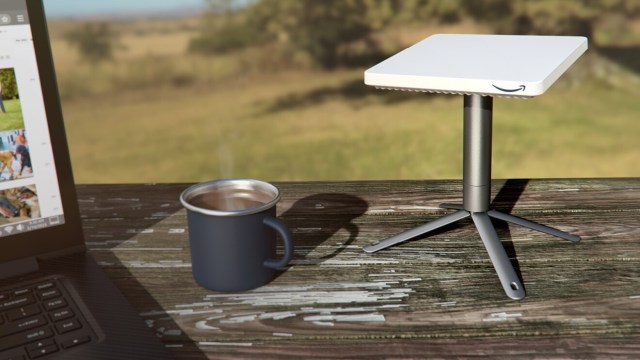
As a global service offering, Amazon’s space internet service will eventually be available from “virtually any location on the planet.” Users will need terminal antennas to tap into the satellite constellation. In 2023, Amazon said that its smallest dish, a seven-inch square design weighing just one pound, would offer speeds up to 100Mbps, making it a Starlink Mini alternative. Amazon will further compete with SpaceX by offering larger dishes for residential and enterprise use offering speeds up to 1Gbps. Amazon expects to produce the terminals “for less than $400 each,” which may or may not be subsidized to attract users.
Amazon’s first-generation satellite system will eventually consist of more than 3,200 LEO satellites, all flying at 17,000 mph (27,359 km/h), 392 miles (630km) above the Earth, and circling the planet in about 90 minutes. SpaceX’s Starlink constellation currently exceeds 7,000 LEO satellites, the first of which launched in 2019.
Notably, the satellites flying on KA-01 are coated in a “dielectric mirror film unique to Kuiper” that scatters reflected sunlight. That should help make them less visible to ground-based astronomers, according to Amazon.
Although Amazon already launched a pair of Project Kuiper prototype satellites, its upcoming mission will include a number of firsts that introduce risk. “We’ve done extensive testing on the ground to prepare for this first mission, but there are some things you can only learn in flight, and this will be the first time we’ve flown our final satellite design and the first time we’ve deployed so many satellites at once,” said Rajeev Badyal, vice president of Project Kuiper.
“No matter how the mission unfolds, this is just the start of our journey, and we have all the pieces in place to learn and adapt as we prepare to launch again and again over the coming years.”
The first batch of 27 Project Kuiper space internet satellites are scheduled to launch next week. Amazon has secured 80 such launch missions that will each deliver dozens of satellites into low earth orbit (LEO) to create a constellation capable of competing with Elon Musk’s Starlink juggernaut. Amazon says it…
