This week, Amazon will launch new Echo hardware designed to supercharge Alexa Plus, the AI-powered upgrade to its voice assistant. I’ve been using Alexa Plus for the last few months as part of its Early Access program, and while the new assistant is off to a promising start, it’s still clearly a work in progress.
Alexa Plus is smarter — but it’s not yet smart enough

To fix Alexa, Amazon had to break it apart and rebuild it. The result is a hybrid smart home assistant, personal assistant, and Amazon’s answer to ChatGPT. Right now, in its Beta phase, this new Alexa isn’t doing any of those things as well as I’d hoped.
This is most obvious in the smart home. Controlling my lights, locks, and robot vacuum with natural language rather than precise phrases is a huge improvement, as is not having to say “Alexa” repeatedly and being able to interrupt, um and er, and change my mind mid-thought. But we are still far from the dream of the ambient home that runs on a Star Trek–style “Computer.”
Today, running on what feels like underpowered hardware and with surface-level integrations into my smart home, Alexa Plus often leaves me frustrated. There’s power under that hood, but it feels largely inaccessible. The assistant desperately needs something to make it more compelling — and better hardware could be the answer.
Alexa Plus should make the smart home smarter
Generative AI is supposed to be a watershed moment for the smart home. By cutting through the complexity of programming your home and removing the frustrations of clunky commands, LLMs should make the smart home more accessible. And in many ways, Alexa Plus delivers.
I can now say, “Alexa, dim the lights in here, adjust the thermostat down a few degrees, lock the front door, and turn the upstairs lights off. Oh, and remind me to take the trash out in the morning,” and it all happens. This kind of easy, hands-free convenience is exactly what the smart home has promised for years.
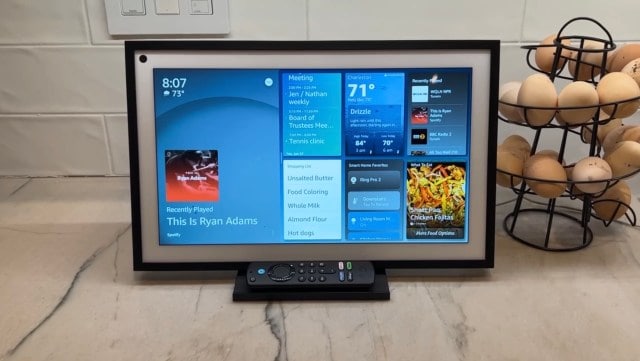

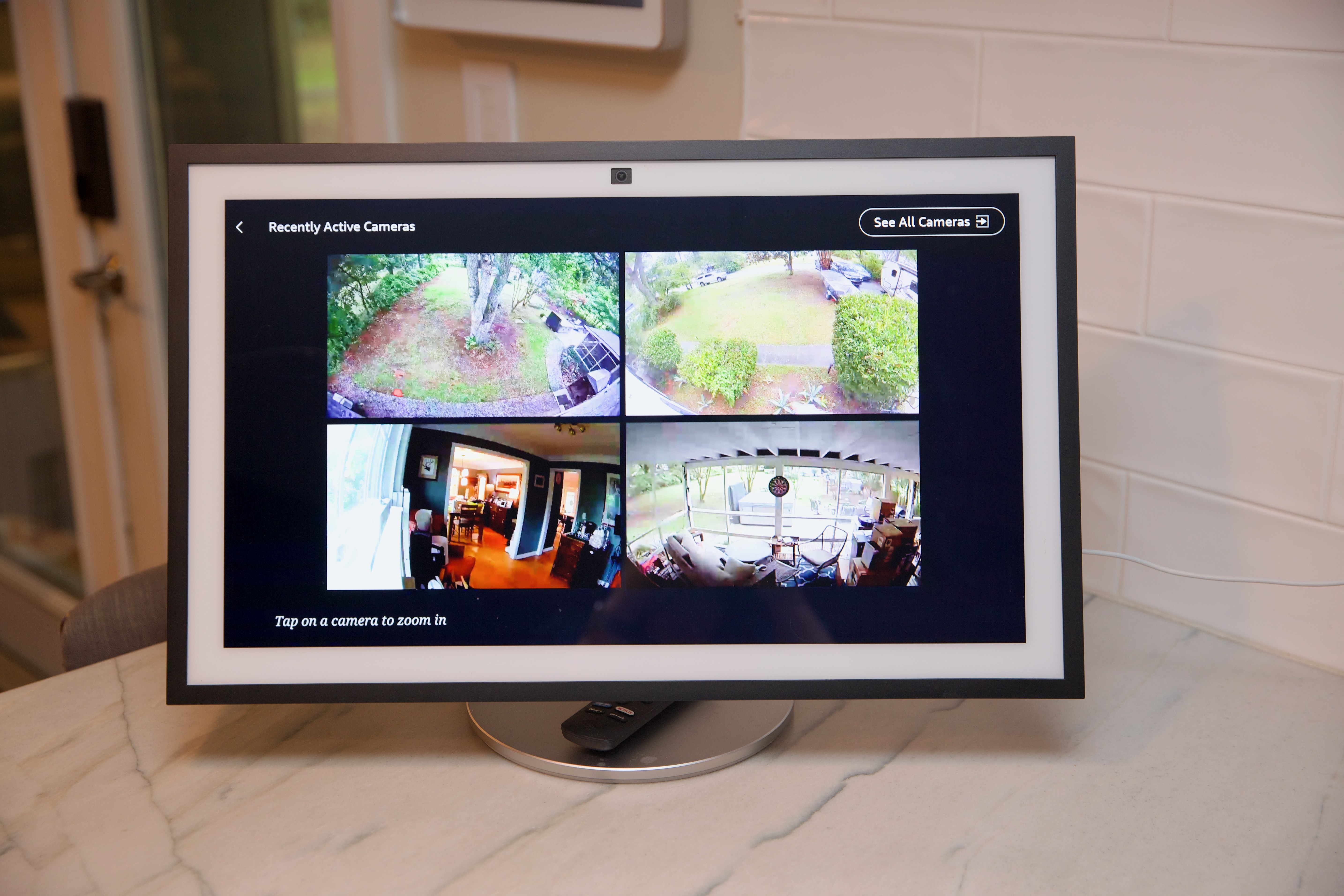
Managing my devices is also simpler. Instead of scrolling through thumbnail clips in the Ring app, I can ask an Echo Show 21 when the cat was last on the porch and instantly see a full-screen video. The updated UI on the Show 15 and 21 is a big improvement, with larger widgets, customizable layouts, and easier access to smart home controls.
Recently, Alexa and I chatted about the best ways to use my smart home gadgets to their full potential. It suggested possible routines, built the automations, tweaked them based on my feedback, and tested them — all in minutes, with no fiddling in the (still clunky) Alexa app. It even helped me set up a new air purifier and folded it into one of those routines.
But there are issues. Alexa Plus is noticeably slower, with some requests taking up to 15 seconds for a response. While turning on lights or adjusting a thermostat is fast enough (I assume due to using local connections over Matter), waiting for over 10 seconds for the weather or a song to play is tiresome.
Some basic features that used to work reliably now don’t or require new phrasing every time. My struggles to control my Alexa-enabled coffee machine persist, and I can’t get Alexa to consistently turn on my bathroom fan for a set period of time.
I used to say, “Turn on the bathroom fan for 15 minutes,” and it did it. Now, Alexa Plus tells me it has to create a routine to do that, and then doesn’t run that routine. Or it says, “Sure,” turns the fan on, but never turns it off. I’ve tried this a dozen times and haven’t had a consistent response yet.
One surreal moment: after weeks of Alexa Plus’ new voice, the old Alexa suddenly surfaced when the system hit a snag. “Sorry, something went wrong,” it said in that stiff, familiar tone. For a second, I wondered — is the old Alexa still in there, trying to get out?
Building the old on top of the new
The old Alexa — the deterministic model built on rigid command-and-control rules — is essentially gone. According to Panos Panay, head of Amazon’s devices and service division, whom I spoke with in February, Alexa Plus runs on an entirely new architecture. One that, based on my testing, feels much more powerful than the old Alexa, but also less reliable.
That’s the paradox of LLMs: they’re excellent at parsing human language, but they’re not designed for consistency. Ask ChatGPT the same question twice, and you’ll get different answers. The unpredictability of LLMs, known as nondeterminism, is a poor fit for smart home control, where reliability and repeatability are crucial. It’s great when you’re brainstorming, but frustrating when you just want your morning coffee.
Amazon’s workaround has been to use its LLM models as a kind of translator. It interprets what you say, then hands off the request to deterministic systems — APIs, device controllers, or local Matter connections.
The unpredictability of LLMs is a poor fit for smart home control, where reliability and repeatability are crucial.
I’ve found this works most of the time, but if the LLM translates a request incorrectly or there’s a gap in the API, it appears that handoff can fail. I assume that’s why my bathroom fan sometimes turns on as requested and why Alexa sometimes insists on creating a routine but then forgets to finish the job.
This is the problem every company with a voice assistant in the smart home is dealing with — merging the old and predictable with the new and exciting. LLMs aren’t designed to be predictable, and what you want when controlling your home is predictability.
Panay says they’ve worked hard to bring predictability to Alexa Plus and to ensure it won’t hallucinate in your smart home. While the former still needs work, so far my smart home has been hallucination-free. There have been no bizarre behaviors such as unlocking doors or cranking up the heat unbidden, or doing something different from what was requested.
However, this tightly controlled structure has resulted in an Alexa Plus that is not the paradigm shift I was hoping for. Of course, it’s still early days, but the promise of LLMs is that they will unlock the potential of technology within our homes — and that hasn’t happened yet.
Alexa Plus hasn’t changed anything for me; it’s just made my smart home (mostly) easier to manage. It still feels like pieces and parts, not a cohesive whole being run by an intelligent machine.
Hardware could hold the key
Many of my frustrations with Alexa Plus are connected to the hardware, and changes here could make a big difference.
The current Show devices are the flagship Alexa Plus interfaces, specifically the Show 21 and 15. But the interplay between voice and screen is still lacking; the hardware remains voice-first.
For example, I’ll ask Alexa to show me the recipe I was just using, and instead, it will read out the directions. With hardware that synchronizes voice and visuals seamlessly, Alexa Plus would be very compelling. (Also, the Shows are the worst Echo devices at hearing commands, and Amazon really needs to fix that.)
Andy Jassy has promised us “beautiful” new hardware for Alexa. As the first products fully designed under Panos Panay, who told me he believes in screens, we have some idea of what’s coming. But ultimately, it will be about how well the hardware and software work together. The devices revealed this week will be Alexa Plus’s moment to prove it’s more than just potential.
Photos by Jennifer Pattison Tuohy / The Verge
Follow topics and authors from this story to see more like this in your personalized homepage feed and to receive email updates.
This week, Amazon will launch new Echo hardware designed to supercharge Alexa Plus, the AI-powered upgrade to its voice assistant. I’ve been using Alexa Plus for the last few months as part of its Early Access program, and while the new assistant is off to a promising start, it’s still…
