Snap plans to start selling its first pair of augmented reality glasses to the public in 2026.
Snap will start selling AR glasses next year

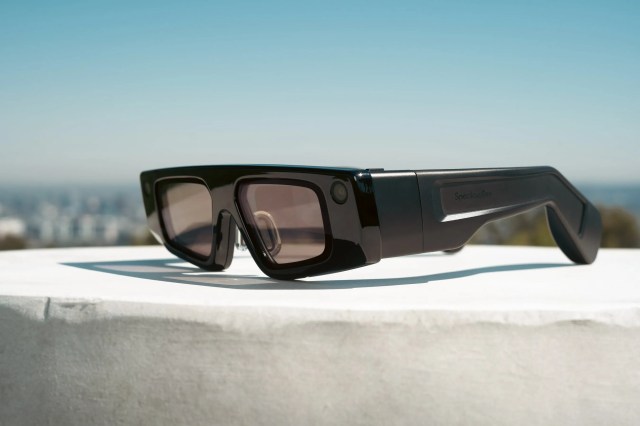
The coming release is part of CEO Evan Spiegel’s decade-plus bet on what comes after the smartphone. He teased it Tuesday onstage at the Augmented World Expo, an augmented and virtual reality developer conference in Long Beach, California.
“Ever since we launched the developer Spectacles nine months ago, folks have been asking, ‘Hey, when’s the public release coming?’” Spiegel tells me ahead of his keynote. Announcing that they’re coming next year gives developers ample time to “think about their timeline for building and polishing the experiences they have,” he says. “And obviously, that’s really important.”
While he’s resistant to offer more details about the hardware, people who have seen prototypes of next year’s glasses tell me they’re noticeably thinner and lighter than last year’s version, which was only available to developers who applied to rent them. They also boast a wider field of view, allowing virtual graphics to fill more of the lenses.
Spiegel won’t tell me how much the glasses will cost, though he does let slip that they’ll be priced less than Apple’s $3,499 Vision Pro. (I expect them to cost much less than that, but still considerably more than the roughly $300 Meta Ray-Ban glasses.) According to Spiegel, next year’s glasses will just be called Specs, rather than Spectacles, since “that’s what everybody calls them already.”
The market for AR glasses is nascent now but shaping up to become crowded. Meta is planning to announce a pair of glasses with a heads-up display later this year. Google just rebooted its smart glasses program with a Gemini-powered version of Android it’s putting in frames from Warby Parker and other eyewear companies. Apple is also still working on AR glasses.
Spiegel says Snap has spent $3 billion to date on Spectacles, which is a small amount compared to the efforts of much players like Meta. Still, Spiegel thinks he has an edge: there are 400,000 developers already building AR effects, or lenses, for Snapchat, which is closing in on 1 billion monthly users. He’s betting on these lenses — which have become increasingly more complex with multiplayer and AI features — as being what differentiates Specs from other AR glasses.
Snap has partnered with OpenAI and Google to let developers use their models to generate lenses. You’ll also be able to talk to the models in Specs via MyAI, Snap’s chatbot that’s already available in Snapchat. Developers can use AI to understand what someone is seeing without footage from the glasses being stored somewhere on a server, which Spiegel is positioning as a win for privacy.
Meanwhile, Snap “spatial intelligence” system uses the models to understand what you’re seeing through the cameras and do things like coach you on how to play pool. Snap is also partnering with Niantic Spatial, the recent spinoff company of the developer behind Pokémon Go, to “build a next generation AI map that will serve as the foundation for AR glasses and AI agents to understand, navigate and interact with the real world,” according to Niantic Spatial spokesperson Jonny Thaw.
Meta has seen early success with its Ray-Ban smart glasses, but the market for AR glasses with displays is unproven. Spiegel knows the bar is high. He has to prove he has a device that people will buy, when he admits that AR glasses won’t fully replace what phones can do anytime soon. Still, he thinks the market opportunity is bigger than smart glasses without displays.
“We’ve seen people experiment with the smart glasses category,” he says. “It has just been hard to to imagine a world where that becomes 10 times better than the phone. Unless you can deliver a product experience that’s that’s 10 times better than the phone, ultimately, the TAM [total addressable market] is just limited, right?”
“Do people want more from their computers? I think the answer is yes.”
He says that the developer version of Spectacles are “already 10 times better at computing in the real world together with your friends,” and that he thinks AR glasses are “going to be 10 times better at AI” because it will “evolve to become spatially aware.”
“I think the question is, at this moment in time, do people want more from their computers? I think the answer is yes.”
Snap plans to start selling its first pair of augmented reality glasses to the public in 2026. The coming release is part of CEO Evan Spiegel’s decade-plus bet on what comes after the smartphone. He teased it Tuesday onstage at the Augmented World Expo, an augmented and virtual reality developer…
